

Want of prosecution is a court's power to dismiss a case that the party who filed it has stopped moving forward, and the trigger and time limit depend on the jurisdiction.
The popular advice to count the days since the last docket entry misses the point. A quiet case may be protected by a stay. A busy case may still face dismissal because nobody completed the particular step the court required. For litigation teams, the useful questions are which rule applies, what event starts it, and what evidence explains the delay.
Want of Prosecution Rules at a Glance
Want of prosecution concerns a party's failure to move a case toward resolution. But courts don't all measure that failure the same way. Some examine conduct and prejudice. Others require a particular filing, appearance, demand, or trial setting.
Want of prosecution triggers, effects and notices by jurisdiction
| Jurisdiction | Rule or statute | Inactivity trigger | Dismissal effect and notice |
|---|---|---|---|
| U.S. federal civil cases | Federal Rule of Civil Procedure 41(b) | Failure to prosecute or obey procedural rules or a court order; no fixed day count | Generally an adjudication on the merits unless the order states otherwise; warning history matters |
| California, trial rule | CCP 583.310 and 583.360 | Failure to bring the action to trial within the statutory trial period | Mandatory dismissal after notice, subject to applicable exclusions and extensions |
| California, discretionary | CCP 583.410 and Rule of Court 3.1340 | Delay in bringing the case to trial or conditional settlement | Discretionary dismissal; a court-initiated hearing requires advance notice |
| New York | CPLR 3216 | Required time after joinder or a preliminary conference order, followed by a qualifying demand | Formal mailed demand gives an opportunity to serve and file a note of issue |
| Texas | Rule 165a | Failure to attend a noticed hearing or trial, or failure to meet disposition time standards | Clerk sends notice; party must show good cause to retain the case |
| Washington | Civil Rule 41(b)(1), as discussed in the state Supreme Court decision below | Failure to note the case for trial or hearing after joinder within the prescribed period | Dismissal without prejudice; timely trial noting before the motion hearing can prevent dismissal |
| Ontario | Status-notice procedure described below; current governing rule requires confirmation | Failure to reach trial-list status or otherwise terminate the action under the applicable procedure | Historical status-notice model provides a cure opportunity before registrar dismissal |
| British Columbia | Case-based dismissal test | Inordinate and inexcusable delay | Court assesses the interests of justice, including prejudice; no universal inactivity countdown |
This is a starting map, not a filing instruction. The detailed deadlines and supporting authorities appear below. In particular, the Ontario status-notice description needs confirmation against the currently applicable provincial rules; the California statute linked later doesn't establish Ontario procedure.
Find the applicable court and procedural track first. Then identify the triggering event and calendar the earliest warning or response obligation, not merely the possible dismissal date. Check the current rule text, local requirements, and operative orders before deciding whether to seek dismissal or rely on a cure.
What Want of Prosecution Means in Practice
Say a building-permit envelope sits unopened in an office. Closing that administrative file might sound like routine housekeeping. Don't carry that assumption into litigation. A judicial dismissal can affect whether the claimant gets another opportunity to pursue the claim.

Separate the outcomes
- Voluntary dismissal: The plaintiff chooses to discontinue the action through an available procedural mechanism. Some voluntary dismissals require judicial approval.
- Administrative closure: The court records a case-management status. Don't assume that status resolves the merits or grants permission to ignore outstanding obligations.
- Dismissal for want of prosecution: The court imposes a judicial disposition because the party hasn't adequately advanced the action or complied with required steps.
The distinction matters when reading an order. Look for the actual disposition, whether it is with or without prejudice, and any conditions. A dismissal without prejudice isn't a promise that refiling remains available. Counsel still needs to evaluate limitation periods and other procedural barriers.
Silence isn't the entire record
The federal decision in Johnson v. Capital One illustrates the fact-specific inquiry into failure to prosecute, including warning, prejudice, culpability, and alternatives to dismissal. That inquiry is more demanding than showing an empty stretch of docket entries.
A lawyer opposing dismissal should explain what happened during the gap and attach the supporting documents. A lawyer seeking dismissal should identify what the plaintiff failed to do and how that failure affected the defense. Neither side benefits from describing every delay as abandonment.
Practical rule: Preserve the explanation while the case is quiet. Reconstructing it after a dismissal motion arrives is slower and less persuasive.
Separate attorney inaction from client-caused delay. Keep attempted contacts, court warnings, remedial filings, and evidence of concrete harm. A curable lapse with limited prejudice presents a different question from deliberate disregard of repeated orders.
Common Causes of Inactivity Findings
Who stopped the case, and why? Start there rather than with the age of the file. Build a chronology that assigns each missed step to a person, an obligation, and a supporting document.
The main operational failure points worth checking are:
- Missed court events or deadlines. Counsel overlooks a status conference, discovery obligation, briefing date, or trial-setting requirement.
- Broken client communication. The plaintiff stops responding, and nobody records follow-up attempts or decides how counsel should proceed.
- Unfinished service. The team hasn't served the defendant, resolved a service problem, or filed the required proof.
- Ignored warnings. An order or dismissal notice reaches the firm but never becomes an assigned task.
- Unmanaged stays. A bankruptcy, arbitration, or related proceeding pauses activity, but nobody tracks what permits or requires the action to resume.
- Open-ended settlement talks. The parties exchange proposals without a signed resolution, an authorized pause, or attention to continuing court obligations.
Distinguish an explanation from an excuse
A court-entered stay gives counsel a document defining what activity was prohibited or deferred. Preserve its scope and termination conditions. Don't assume it suspended every obligation in the case.
Opposing-party delay also needs specifics. If discovery couldn't proceed because the defendant withheld a required response, retain the request, correspondence, and any motion addressing the problem. An unexplained assertion that the other side was difficult is weak evidence.
Consider two hypothetical files. In one, counsel dies unexpectedly and replacement counsel promptly documents the disruption and seeks directions. In the other, a firm loses track of the matter during an internal handoff. Those situations call for different explanations and different remedial steps; neither should be reduced to the same inactivity label.
A reason for delay is useful only if counsel connects it to the obligation that went unfulfilled.
The cause of the gap, the party's response, and the available proof often matter as much as its length.
How Federal Courts Weigh Delay Against the Merits
Federal failure-to-prosecute analysis addresses both failure to advance the action and failure to comply with procedural requirements or court orders. A defendant may request dismissal, but the court can also initiate it. That makes passive reliance on opposing counsel's silence a poor risk-control strategy.
In LeBeau v. Taco Bell, Inc., twenty-six months of plaintiff inaction supported affirmance after the appellate court found a clear record of delay and no adequate lesser remedy. The lesson isn't that this duration creates a universal deadline. The documented conduct and the adequacy of alternatives supported the result.
Questions the record must answer
- What caused the delay? Identify the unmet obligation, its due date, and the person responsible. Separate unexplained inactivity from court-authorized postponement.
- Was dismissal clearly threatened? Preserve the warning and evidence that it reached the relevant party or lawyer.
- What harm followed? Connect missing witnesses, unavailable records, or impaired preparation to the delay rather than merely asserting prejudice.
- What happened after intervention? Show whether counsel responded to orders, proposed a workable schedule, or continued to disregard the case.
Federal balancing factors for dismissal under Rule 41(b)
| Factor | What the court examines | Why it matters |
|---|---|---|
| Length and cause of delay | Duration, responsibility, and explanation | Distinguishes a temporary lull from sustained failure to proceed |
| Notice of possible dismissal | Warnings and opportunities to respond | Shows whether the plaintiff had a fair chance to act |
| Prejudice to the opposing party | Lost witnesses, unavailable records, or impaired defense preparation | Concrete harm supports stronger sanctions |
| Docket congestion | The effect of dormant litigation on court management | Places the delay in its case-management context |
| Lesser sanctions | Warnings, fines, or preclusion orders tried or considered | Tests whether dismissal is necessary |
| Willfulness or bad faith | Evidence of intentional disregard rather than an isolated mistake | Helps establish culpability |
Build evidence, not adjectives
Calling conduct egregious won't replace docket entries. Attach the relevant orders, identify the unanswered obligations, and explain why a narrower sanction would or wouldn't work. Conversely, an opposition should offer a credible cure, not just an apology.
Use a consistent review process for federal civil cases, but don't treat the factors as a nationally uniform scoring system. Counsel must check the controlling appellate standard.
Dismissal is an extreme sanction. A useful assessment asks whether a warning, revised schedule, or targeted sanction could still move the matter toward a merits decision.
Fixed Deadlines That Start Running in State Courts
State procedures can turn on a specific milestone rather than a general impression of abandonment. Start with Washington, where the timing of a trial note can matter more than the latest correspondence in the file.
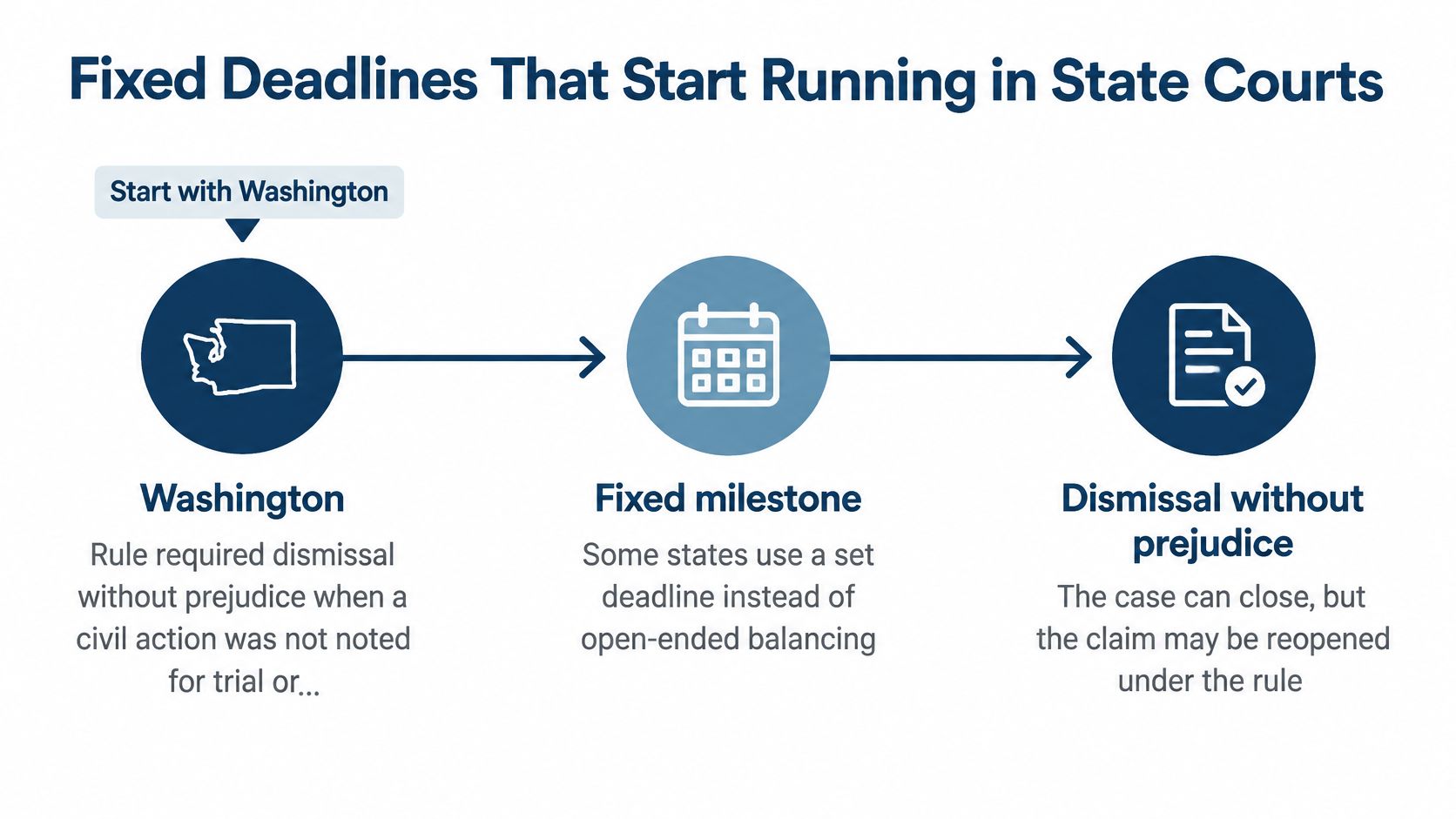
Washington and New York
The Washington Supreme Court's 1997 decision explained that the rule, substantially in place since 1967, required dismissal without prejudice when a case wasn't noted for trial or hearing within one year after joinder of an issue, unless the moving party caused the failure. The decision also explains the important cure: noting the case for trial before the dismissal motion is heard prevents dismissal under that provision.
For a Washington review, locate the joinder event and check the trial-note record. Don't substitute the complaint's filing date for the rule's triggering event.
Under New York CPLR 3216, the prerequisites include joinder and the later of one year after joinder or six months after a preliminary conference order, followed by a registered or certified mailed demand allowing 90 days after receipt to serve and file a note of issue. The demand must warn of the dismissal consequence; timely service and filing of the note constitutes sufficient compliance.
That means the New York file needs more than a demand date. Preserve the demand itself, mailing evidence, receipt information, and proof of the responsive filing.
Texas requires attention to the hearing
Texas Rule of Civil Procedure 165a addresses failure to appear at a noticed hearing or trial and failure to dispose of a case within Supreme Court time standards. The clerk must send notice of the intended dismissal and identify the dismissal hearing's date and place.
At that hearing, the party seeking to keep the case active must show good cause. If the court retains it, the resulting pretrial order establishes trial and preparation obligations. Retention isn't permission to return the file to an inactive shelf.
- Before the hearing: Assemble the explanation and proposed path forward.
- After retention: Assign the obligations in the new order and preserve proof of compliance.
Each state starts its own procedural clock. Read the trigger language before calculating anything.
Calculating Trigger Dates, Tolling and Cure Periods
California requires separate tracking for its mandatory trial deadline and its discretionary delay procedure. Combining them into one inactivity alert hides the legal distinction.
Calculate the trial deadline separately
California Code of Civil Procedure section 583.310 requires an action to be brought to trial within five years after commencement against the defendant. The mandatory dismissal framework requires attention to applicable exclusions, extensions, notice, and the actual trial deadline, not just elapsed calendar time.
The tolling protection described in that statutory framework addresses circumstances where an exclusion or extension leaves less than six months, allowing the action to reach trial within six months after the exclusion or extension ends. Before applying that protection, counsel should verify the related statutory provisions and the particular event's legal effect.
For a worked calculation, suppose a qualifying exclusion ends with less time remaining than the statutory protection allows. Record both the original trial deadline and the adjusted deadline. Attach the order or other authority supporting the exclusion. Don't overwrite the original date and erase the calculation history.
Keep discretionary review and notice apart
California section 583.410 authorizes discretionary dismissal for delay under Judicial Council procedures. Counsel must also check the operative text of Rule of Court 3.1340 before applying its trial-delay benchmark or court-initiated hearing notice requirements; the statute alone doesn't reproduce those details.
Ontario needs a separate verification step. A status-notice procedure is sometimes described as a trial-list trigger followed by an opportunity to cure before registrar dismissal with costs. Don't apply that description as current Ontario law without checking the governing provincial rule and any transitional provisions. A California statute cannot establish an Ontario deadline.
Calculation control: Store the legal trigger, the date calculation, and the supporting document as separate fields.
For every applicable procedure:
- Record the starting event. Identify commencement, joinder, receipt, or another legally specified trigger.
- Document adjustments. Capture the authority, scope, and ending condition of each exclusion or extension.
- Verify completion. Retain proof that the required cure occurred.
Check court days versus calendar days before configuring reminders. The governing counting rule, service method, weekends, and holidays all deserve review rather than an assumed setting.
Why Canadian Courts Apply a Different Test
Don't export a U.S. state deadline into a Canadian matter. And don't treat Canada as a single procedural jurisdiction. British Columbia's case-based approach illustrates why an elapsed-time dashboard cannot supply the legal answer by itself.
In Mousa v. Thurber Engineering Limited, 2025 BCSC 2247, the analysis addressed roughly six years and four months of gross delay, while still separating excusable periods from inexcusable ones. Total elapsed time was therefore not a substitute for examining responsibility and circumstances.
Distinguish the stages of the test
- Inordinate delay: Assess the delay in the context of the litigation, not against an invented universal inactivity limit.
- Inexcusable delay: Identify the explanation for each relevant period and whether the evidence supports it.
- Interests of justice: Examine prejudice and the broader circumstances before treating dismissal as the appropriate outcome.
A cross-border litigation team needs a chronology that supports those distinctions. A list of docket entries is a useful starting point, but it won't necessarily explain why discovery paused, whether settlement discussions affected progress, or what happened during a change of counsel.
Keep event dates and legal conclusions separate
Record the beginning and ending of each claimed interruption. Link correspondence, orders, discovery records, and counsel-transition documents to the relevant period. Then let the responsible lawyer assess its legal significance.
Settlement discussions, for example, should not automatically become an excused period in the system. Store what the parties agreed, what work continued, and whether any court order changed the schedule. The same discipline applies to counsel changes: document the transition without assuming it excuses every resulting gap.
The British Columbia test concerns matters governed by that jurisdiction's law. Other provinces may use different rules, notice procedures, and dismissal mechanisms. A shared matter-management workflow should preserve those differences rather than force every Canadian file into one inactivity category.
Build a Dismissal Risk File Before the Next Deadline
An inactive-looking matter can produce a dispositive ruling. Build the record before a warning forces the team to reconstruct it under pressure. Separate routine pauses from events that change the case's legal position.
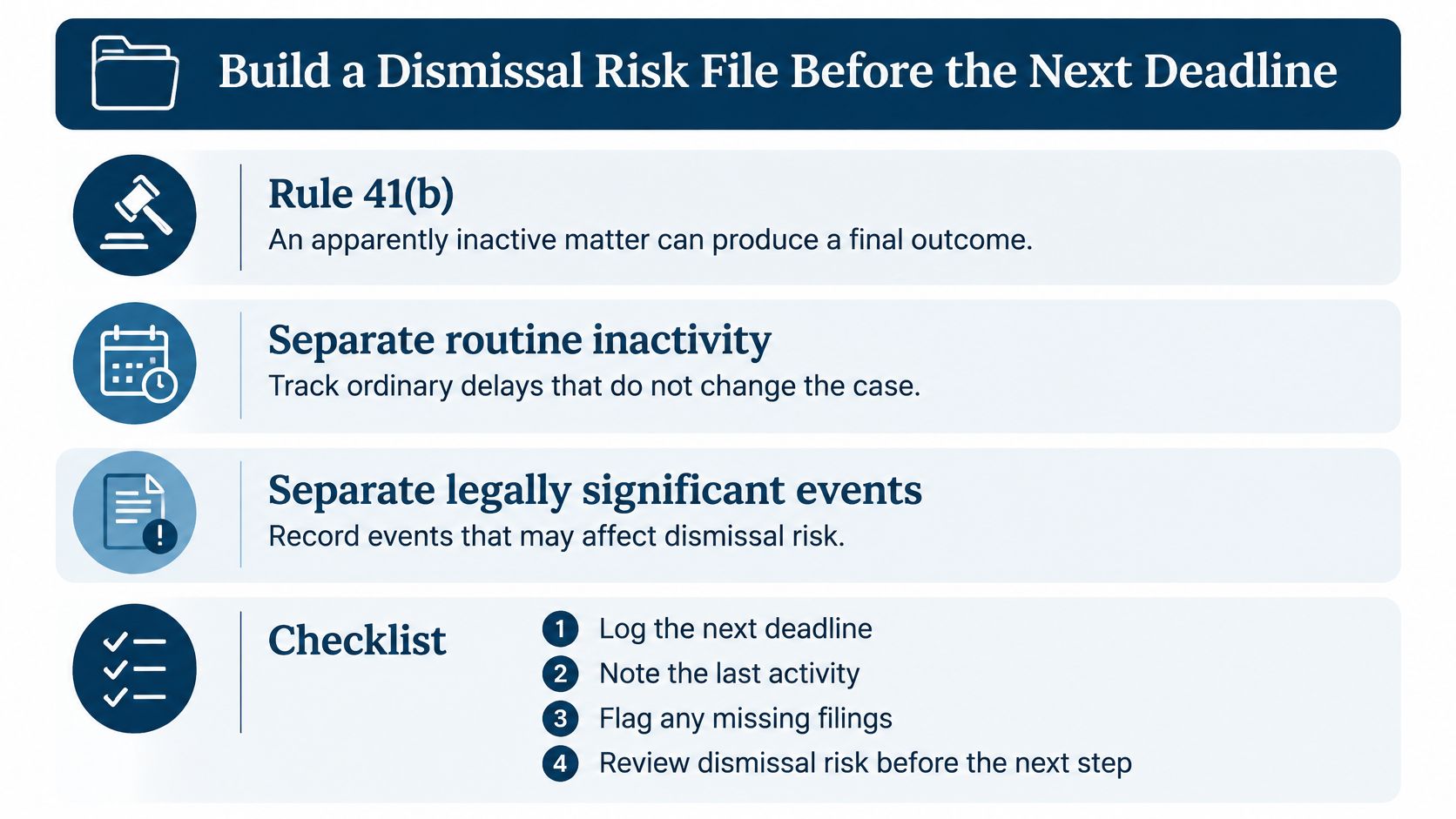
Keep the documents that explain the risk
- The triggering order or notice. Attach the complete document and identify the governing procedure. A calendar title isn't enough.
- Trigger, notice, and cure dates. Keep the calculation and an earlier internal escalation date. Record assumptions requiring attorney review.
- A responsible attorney and backup. Name who must act and who receives an escalation if that person is unavailable.
- Contact history. Preserve dated attempts to reach the client or opposing counsel, including unanswered messages.
- Proof of service and receipt. Keep envelopes, mailing records, electronic notices, and delivery evidence where relevant.
- Reasons for inactivity. Link stays, bankruptcy materials, service problems, and settlement correspondence to the periods they explain.
- Concrete prejudice. Identify unavailable witnesses, missing records, or impaired preparation, with supporting evidence.
- Remedial steps. Retain filings, appearance records, revised schedules, and proof that promised work was completed.
This file serves both sides of a motion. It helps the plaintiff explain a gap and propose a credible cure. It helps the defendant distinguish genuine prejudice from frustration with slow progress.
Review authority and ownership together
A Texas appellate decision discussing rule-based and inherent dismissal authority explains why reviewing express deadlines alone can miss risk. Check court orders and the broader prosecution history, particularly where no single missed filing explains the case's condition.
Use automated docketing to support that review, not replace legal judgment. Someone still needs to validate the trigger and confirm that a filing or appearance satisfies the actual requirement.
At MatterAlert, we can reassign all events, appointments, and tasks to a new attorney across one or multiple matters with a few clicks when an attorney departs; changes automatically sync to all subscriber calendars. Our docket availability and rule coverage vary by court and jurisdiction, especially in Canada, so confirm specific courts and rule sets during a demo.
Start this week with matters approaching a trigger or carrying an unresolved warning. Open the actual notice, confirm the owner, and assemble the documents needed to explain the next required step.
MatterAlert brings matter information, deadlines, tasks, documents, and calendar coordination into a shared workspace so your team can track dismissal-related obligations alongside the supporting record. Visit MatterAlert to arrange a demo using your firm's courts, notice procedures, and attorney-handoff needs.