

Roughly two-thirds of a sample of 148 federal class actions ended in voluntary or court-ordered dismissal, rather than settlement, according to the Federal Judicial Center's empirical study of class actions. Filing a case is a long way from paying class members. And even when the parties settle, notice failures, incomplete claims and distribution problems can separate the announced value from money people receive.
For litigation teams, the useful question isn't just whether a case will settle. It's which decision, deadline and responsible person stand between the current stage and a completed payment.
What a Class Action Is and Why Rule 23 Matters
A class action is a lawsuit brought by representatives for a larger group with shared claims. Think of a group travel ticket: one document covers many people, but someone still needs to establish who belongs on the trip. In litigation, the court decides whether the proposed representatives can proceed for the group.
Modern U.S. class actions rest on Federal Rule of Civil Procedure 23, first adopted in 1938 and substantially revised in 1966, when the modern damages-class framework and absent members' opt-out rights took shape, as the federal judiciary's historical account explains. That account describes drafters anticipating classes of approximately 100 people, such as victims of an airplane crash or fire, while later cases involved thousands or more claimants.
One claim pattern, many individual records
Suppose vehicle owners allege that the same component has a defect. A shared design question may support collective litigation, but the team still needs to distinguish purchase records, affected products and claimed losses. For a concrete vehicle-defect context, Olson & Sons' Hawaii Nissan defect lawsuit guide is a useful companion to the procedural questions.
The economic purpose matters. Group proceedings can make claims practical to pursue when separate lawsuits would cost more than the potential recovery. But aggregation doesn't erase differences among members.
Operational consequence: One court matter can require a population-sized notice and claims workflow.
For working lawyers, that means maintaining both a litigation record and a reliable member-administration process. The docket tracks orders and hearings. The administration record tracks who received notice, responded or needs follow-up.
Rule 23 preserves judicial oversight through certification, representation, notice and exclusion requirements. A proposed class therefore isn't a mailing list attached to a complaint. It's a collective proceeding that must remain justified as the evidence and proposed resolution develop.
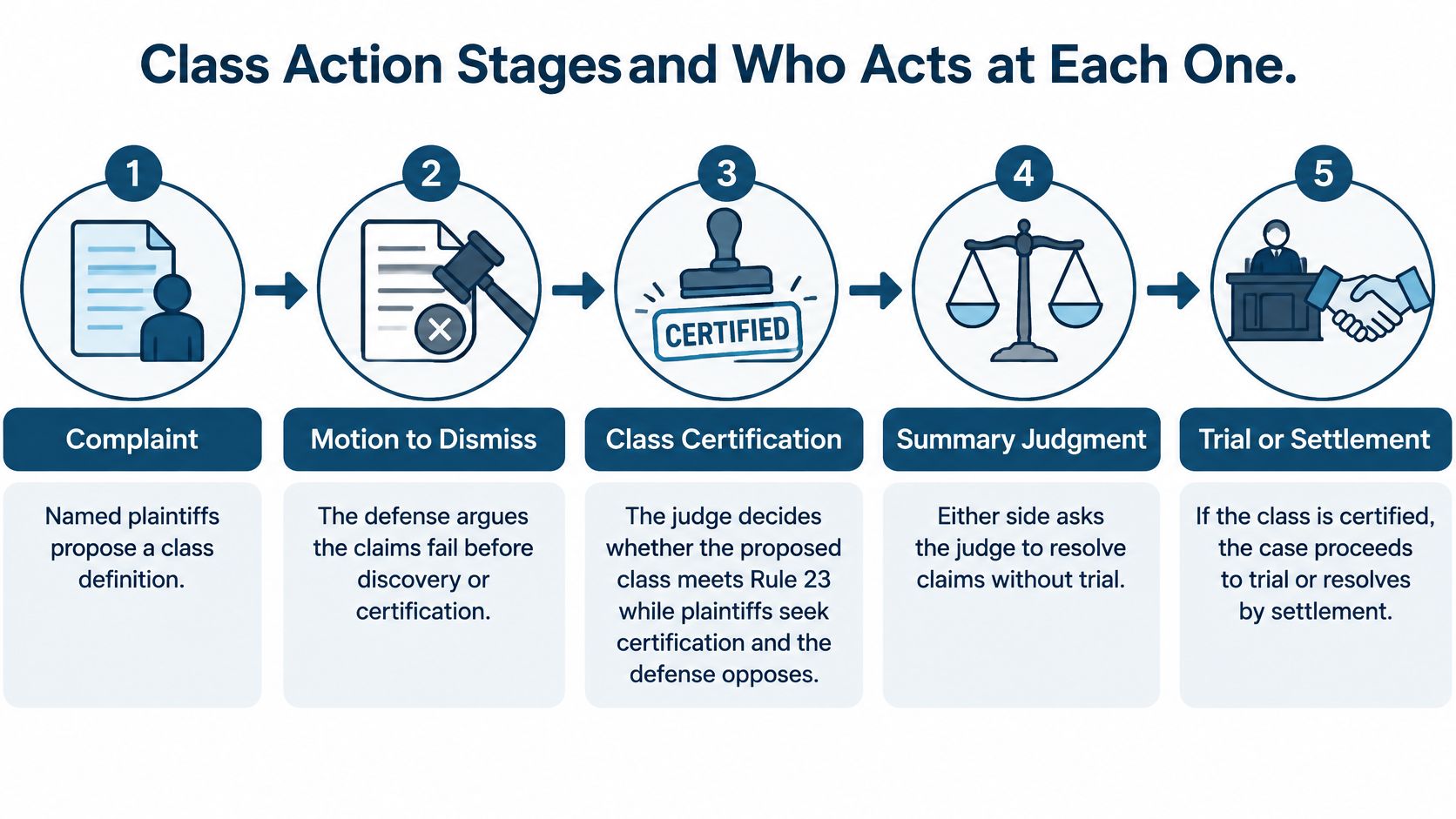
Class Action Stages and Who Acts at Each One
| Stage | What happens | Who acts |
|---|---|---|
| Filing and complaint | Plaintiffs propose a class definition | Named plaintiffs and class counsel |
| Motion to dismiss | Defense argues the claims fail before certification | Defense counsel and the court |
| Class certification | Court tests Rule 23 requirements on the evidence | Court, both sides and experts |
| Notice | Class members learn about the case and their options | Claims administrator and counsel |
| Opt-out and objections | Members exclude themselves or challenge the deal | Absent class members and counsel |
| Final approval | Court reviews whether the settlement is fair | Court and parties |
| Appeal period | Objectors may appeal the approval order, subject to applicable requirements | Objectors and parties |
| Claims and distribution | Eligible members submit required claims and receive approved payments | Claims administrator |
The timeline below summarizes the contested-litigation track. The table also captures settlement administration, where members' choices and payment tasks become central.
Locate the case before assigning the task
The complaint proposes collective treatment; it doesn't establish that the class exists for litigation purposes. A dismissal motion challenges the claims, while certification addresses whether the court should resolve them collectively. Summary judgment and trial belong on the merits track, though parties may negotiate a settlement before reaching either.
Settlement changes the workflow. Notice must describe the proposed deal and available choices. Final approval requires judicial review, and payment may remain contingent on the agreement's effective-date provisions and any appeal.
The sequence isn't rigid. Settlement notice can precede final settlement certification, and claim submission may close before final approval. Use the actual order and agreement, not the table's row order, to calculate dates. MatterAlert's overview of federal civil cases provides broader procedural context for placing class-specific events within the underlying lawsuit.
Case subject matter also affects what counsel must investigate. Kons Law's discussion of notable class actions against broker-dealers offers a sector-specific comparison without making every securities dispute procedurally identical.
A case can end before payment, or continue without collective treatment. Record the current stage, the next controlling event and the person responsible for acting. That prevents staff from opening a distribution workflow while certification or approval remains unresolved.
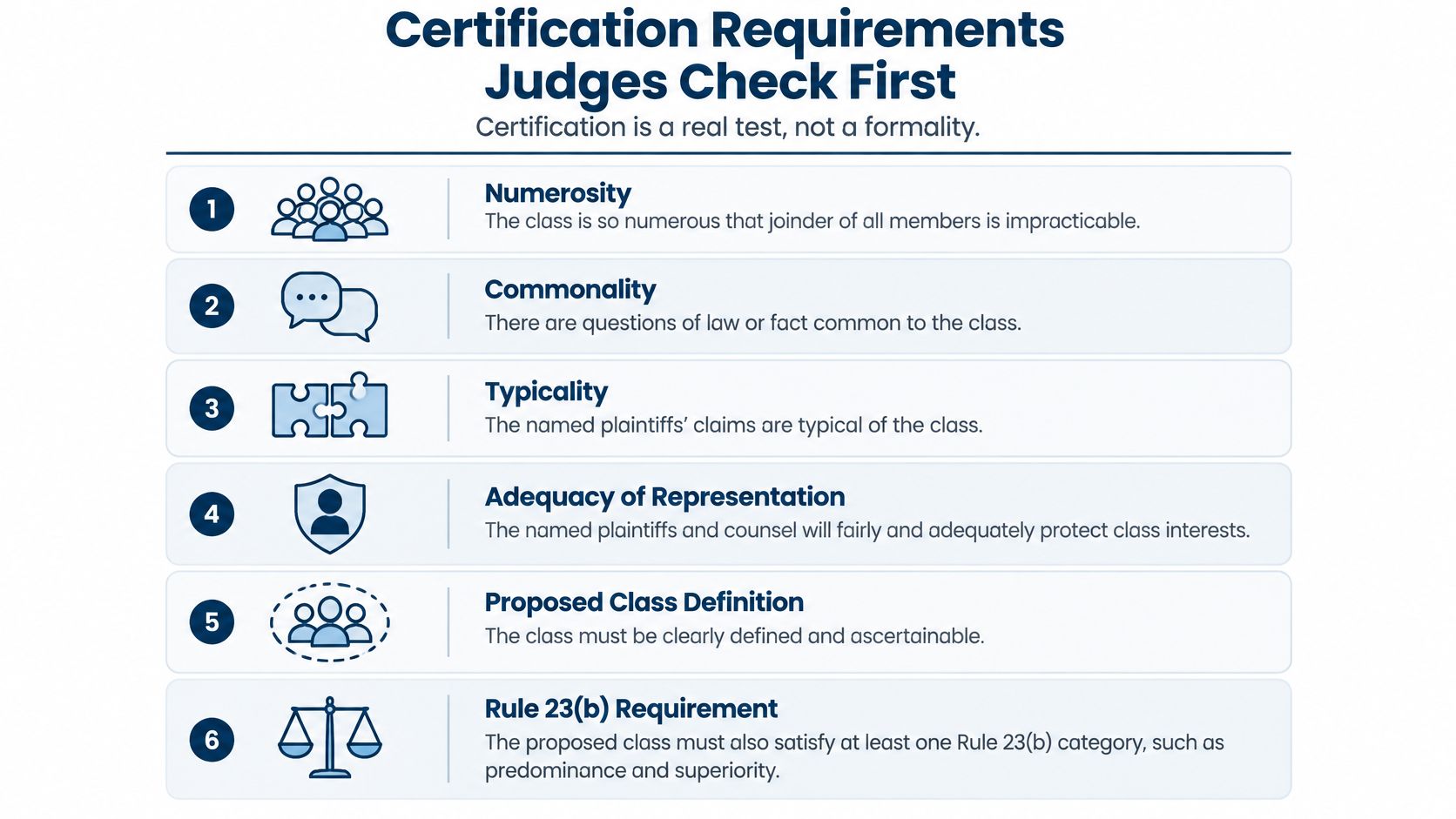
Certification Requirements Judges Check First
Failed certification can end the class route, even when individual claims remain. The court needs evidence supporting collective treatment, not merely an allegation that many people experienced something similar.
Rule 23's statutory text requires numerosity, commonality, typicality and adequacy, plus satisfaction of an applicable category under Rule 23(b); damages classes under Rule 23(b)(3) must also establish predominance and superiority.
| Requirement | What the judge checks | Common failure point |
|---|---|---|
| Numerosity | Joinder of all members is impracticable | A small, readily joined group |
| Commonality | Shared legal or factual questions support common answers | Each claim requires a separate factual inquiry |
| Typicality | Representatives' claims are typical of the class | A representative faces a material unique defense |
| Adequacy | Representatives and counsel protect class interests | Conflicts or insufficient resources |
| Predominance | Common questions outweigh individual questions | Individual causation or injury inquiries overwhelm common proof |
| Superiority | Class treatment is preferable to practical alternatives | Separate proceedings offer a better resolution |
These are diagnostic failure points, not automatic disqualifiers. Different damages amounts alone don't establish that collective treatment is impossible. Counsel must explain whether a workable method can resolve liability and allocate recovery without overwhelming individualized proceedings.
Build the evidence map at intake
A class definition needs careful drafting, but it isn't a substitute for proving the rule's requirements. Identify who belongs in the proposed class without assuming that everyone has already established liability.
Capture the following before the briefing schedule becomes urgent:
- Class boundaries: Relevant products, transactions, locations and periods.
- Representative standing: The named plaintiff's alleged injury and supporting records.
- Common proof: Contracts, policies, transaction data and other evidence that can answer shared questions.
- Individual variables: Causation, injury, defenses and damages inputs requiring member-specific work.
- Potential subclasses: Groups with materially different interests or legal positions.
- Briefing dependencies: Discovery completion, expert reports, motion papers and hearings.
Suppose customers challenge a uniform bank charge. The account agreement may provide common evidence. But if the charge arose from materially different agreements or practices, counsel must address those differences rather than label every account holder alike.
Track decisions, not just filing dates
Create separate events for the certification motion, opposition, reply, hearing and resulting order. Attach the controlling source to each event. When the court changes the schedule, review expert and discovery tasks as well as the visible motion deadline.
The analytical point is simple: certification risk should influence case design before settlement administration begins. A broad proposed class may increase apparent exposure while weakening the proof needed to proceed collectively.
Who Does What in a Class Action
A class action needs clear authority, not just a large contact list. Distinguish who makes legal decisions, who performs administrative work and who approves the result.
- Named class representative: Participates in the case and understands the claims sufficiently to supervise counsel and protect the represented group.
- Class counsel: Develops the evidence, conducts litigation and negotiates proposed relief while fulfilling duties to the class.
- Absent class members: Evaluate the choices available under the notice and applicable class category.
- Objectors: Present qualifying challenges to a proposed settlement or fee request for the court to consider.
- Defense counsel: Tests the claims and collective-treatment theory through dismissal, certification opposition or decertification arguments.
- The court: Decides certification, directs notice where required, and reviews proposed settlements and fees.
- Claims administrator: Executes the approved notice, claim-review and payment procedures.
Separate agreement from approval
Say a bank-fee case reaches a proposed settlement. The representative authorizes the proposal with counsel's advice. Counsel negotiates the fund and release, the administrator sends the approved notice, and the judge evaluates whether the proposed resolution should bind the class.
Those actions aren't interchangeable. The representative can't replace judicial approval. And the administrator shouldn't rewrite eligibility criteria because a different process would be easier to operate.
A completed administrative task doesn't establish that the underlying legal decision was authorized.
Access should follow those distinctions. An administrator may need contact details and transaction fields without access to privileged strategy. An expert may need a controlled dataset rather than the complete case file.
Even one person may act in different capacities across related matters. Assign permissions by responsibility and document sensitivity, rather than by job title. That makes the case record more useful without exposing every participant to information they don't need.
Opt-Out, Objection and Claim Deadlines Explained
The notice date is a starting point for checking the calendar, not a universal trigger for every deadline. Read the order to determine which dates run from notice, approval, service or another event. Some orders set fixed dates instead.
An opt-out deadline governs exclusion where that choice is available. Timely exclusion generally preserves the ability to pursue an individual claim outside the class resolution, subject to other legal limits. An objection deadline serves a different purpose: it lets a member challenge the proposed deal while remaining in the class.
Different choices require different records
Don't combine exclusion requests, objections and claims into a single response count. They express different choices and require different review.
| Event | Record to preserve | Consequence to check |
|---|---|---|
| Notice | Dispatch details and delivery results | Whether follow-up or corrected notice is needed |
| Exclusion | Request, receipt date and validation | Whether the member leaves the class |
| Objection | Submission and required supporting information | Whether the court will consider the challenge |
| Claim cutoff | Submission timestamp and confirmation | Whether the request qualifies for review |
| Deficiency cure | Defect notice and corrected response | Whether an incomplete claim becomes valid |
| Distribution | Release conditions and payment status | Whether approved compensation reaches the member |
The claim cutoff isn't necessarily the same as the exclusion or objection deadline. A member may remain bound by a settlement yet receive no claims-based payment after missing the filing requirement. Conversely, submitting a claim doesn't itself establish that the administrator will approve it.
A hypothetical missed-date chain
Suppose an order gives members 60 days after notice to opt out and sets the claim cutoff 90 days after final approval. These are hypothetical terms, not default legal periods. Calendar them only after confirming that the actual order uses those triggers.
A member who misses the exclusion window may lose that route out of the settlement. If the member then submits a claim missing required documentation, a deficiency notice may offer a chance to correct it. Missing that cure deadline can defeat payment even though the original claim arrived on time.
Calendar control: Preserve the trigger, calculation method, governing document and responsible reviewer together.
Final approval doesn't necessarily authorize immediate payment. Check the effective-date provisions, appeal conditions and distribution instructions. When an amended order arrives, identify every dependent task before changing dates, and retain the superseded order so the team can explain what changed.
Why Settlement Value Overstates What Members Receive
A settlement fund isn't a distribution total. In an analysis of 149 consumer class-action settlements from 2013–2015 requiring claims, the Federal Trade Commission found a median claims rate of 9% among direct-notice recipients and a weighted mean of 4%. Those measures concern people directly notified, not necessarily the entire eligible class.
The photograph captures the concern, but a small individual check and low participation are different problems.

Replace the headline with a distribution ledger
Track each field separately:
- Settlement fund: The amount committed under the agreement, with permitted deductions identified.
- Estimated eligible population: The group potentially entitled to relief.
- Notice recipients: People directly reached, distinguished from attempted deliveries.
- Claims submitted: Requests received before validation.
- Approved and rejected claims: Separate outcomes, with rejection reasons.
- Payments issued: Checks or electronic payments sent.
- Funds distributed: Completed payments, with unresolved items identified.
These fields locate different failures. Undeliverable notices call for a delivery review. Abandoned forms call for a usability review. Rejected claims require attention to eligibility and documentation. Uncashed checks require payment follow-up, not another certification motion.
For counsel comparing negotiated structures, Mediation & Negotiation Services (M&N) discusses class action settlement options. The practical question is whether the chosen structure can deliver the promised relief under the approved terms.
Intervene before the cutoff
Set interim participation reviews early enough to act. If submissions remain low, counsel can evaluate reminders, clearer instructions or simpler submission procedures, subject to the order and privacy requirements. Don't assume an administrator can change material claim conditions without authorization.
Claims-based and automatic-payment settlements also need different dashboards. The absence of a claim form doesn't prove successful delivery.
Finally, assign ownership for residual funds. Reconcile failed payments and outstanding checks, then follow the approved plan for any remainder. Closing the matter before that accounting is complete can conceal the final gap between promised compensation and completed recovery.
Managing Multistate Class Actions Across Courts
The Class Action Fairness Act of 2005 gives federal district courts jurisdiction over many interstate class actions involving more than $5 million in controversy, excluding interest and costs, permits aggregation of members' claims, and uses an expanded diversity framework that can be satisfied when any class member and any defendant are citizens of different states. Other statutory conditions and exceptions still matter.
That threshold is an intake screening point, not a damages award or a guarantee of federal jurisdiction. Counsel must assess the proposed class, citizenship, alleged value and applicable exceptions before deciding how the jurisdictional rules affect the case.
Parallel proceedings need separate clocks
Suppose defense counsel is assessing removal of a newly served state-court complaint while another team handles a response deadline in a related federal action. The matters concern similar allegations, but their procedural triggers aren't interchangeable. A filing in one proceeding shouldn't overwrite the calendar in another.
Use a central record that preserves:
- Court identity: Jurisdiction, case number and assigned judicial officer.
- Controlling documents: Orders, service records and the applicable local-rule version.
- Event dependencies: Which task changes when a particular hearing or filing moves.
- Related-matter connections: Shared issues without merging independent schedules.
- Decision ownership: The lawyer who approves jurisdictional analysis and the staff member who maintains the dates.
A shared workspace should make differences visible. It shouldn't create the impression that related cases share one schedule.
Standardize the process, not the legal answer
Matter templates help teams ask the same intake questions. They shouldn't supply a jurisdictional conclusion before counsel reviews the facts. The distinction is central to effective legal operations management: standardize collection, assignment and verification while preserving legal judgment.
For notice and settlement work, maintain a separate schedule for each affected proceeding unless an order expressly coordinates them. A revised hearing date in one court may leave another court's objection deadline untouched.
Cross-border practices need an additional boundary. U.S. federal class-action procedures aren't a substitute for the rules governing Canadian proceedings. Keep the court, procedural regime and controlling documents explicit in every related matter.
The resulting record should answer a practical question without guesswork: Which order requires this action, in which case, and who must complete it? That's more useful than a consolidated calendar that hides where each obligation came from.
Confirm Every Deadline Before the Next Court Date
Start with the latest court order and controlling rule set. Then verify notice, exclusion, objection, claim and distribution events against their actual triggers. Don't treat an old calendar entry as proof that the date remains correct.
Run a source-to-calendar check
- Verify authority: Attach the current order or rule to the event.
- Assign accountability: Name the person responsible for completion and the reviewer.
- Inspect dependencies: Check whether an amendment changed related tasks.
- Confirm access: Record who can view sensitive member information.
- Review exceptions: Escalate incomplete tasks before the external deadline.
Rule-based calculation can help with weekend and holiday adjustments, but the team still needs the correct trigger and rule. Distinguishing court days from calendar days is part of that review, not a clerical detail.
Test the calendar against the source document, not against another copy of the calendar.
Pick an active matter and list its next three deadlines. Confirm that each has an owner, a source order and a documented calculation. Test MatterAlert against that checklist during a demo, including specific courts and rule sets: our docket availability and rule coverage vary by court and jurisdiction, especially in Canada.
MatterAlert combines CalendarRules deadline calculation, PACER and UniCourt docket access, matter templates, tasks, audit logs and Outlook synchronization in a matter-centered platform. Our rule-based calculations, notifications and task escalation help teams reduce missed-deadline risk across certification, notice and distribution work. Visit MatterAlert to arrange a demo using an active class-action schedule and verify the coverage your team needs.