

It's 5:40 pm. Your calendar shows a full day. Your timesheet shows 3.2 hours. And somewhere between the calls, the redlines, and the two-minute emails you never logged, the money leaked out.
That's why calculating billable hours isn't really about arithmetic. It's about capture, rounding, and proof. Get one step wrong and every invoice after it inherits the error.
The Core Formula and Time Increments Explained
Start simple. Billable hours equal minutes spent on a client task divided by 60, then adjusted to the unit your firm bills in. That's the whole formula. The trouble starts with the adjustment.
Every entry carries two numbers, and you need both. Actual time is what you spent. Billed time is what the increment turns it into. If your system stores only one of them, you can't audit the other later.

Why the unit matters more than the math
A 6-minute unit, or 0.1 hour, is common in US law firms. Under that unit, a 14-minute call bills as 0.3 hours. Under a quarter-hour unit, that same call bills as 0.25 hours. Same work. Different invoice.
Check the unit before anyone enters time. The engagement letter or the client's billing guidelines usually set it. Because if the unit is wrong, it isn't wrong once. It's wrong on every entry in the month, and fixing it means touching each one.
Annual targets don't settle this either. The National Association for Law Placement billable hours data reported that a 2,000-hour requirement represented only a minority of reported firm minimums in its 2009–2010 analysis. A target tells you what the firm expects. It doesn't tell you what a single task bills.
| Increment | Minutes per unit | Units per hour | Billed value for a 14-minute entry |
|---|---|---|---|
| 0.1 hour (6-minute) | 6 | 10 | 0.3 |
| 0.2 hour (12-minute) | 12 | 5 | 0.4 |
| 0.25 hour (quarter-hour) | 15 | 4 | 0.25 |
| 0.5 hour (half-hour) | 30 | 2 | 0.5 |
| 1.0 hour (full hour) | 60 | 1 | 1.0 |
Read that last column slowly. The coarser the unit, the bigger the jump on short work. A half-hour unit turns 14 minutes into 30. Clients notice that. So do their billing auditors.
Practical rule: Record actual minutes first, then convert. Never enter the rounded figure as if it were the time you actually spent.
Here's one entry worked end to end. You spend 14 minutes on a call. At a 0.1-hour unit rounded up, that becomes 0.3 hours. At an example rate of $350 per hour, the entry bills $105. Actual time, billed time, rate. Three separate facts, and the invoice needs all three.
How to Record and Round Time Step by Step
Good entries are boring. They're made the same way, in the same order, every day. I'd run them as a pipeline, not as a memory exercise at month end.
The 2022 Clio Legal Trends Report reported 33% utilization, 84% realization, and 89% collection for that year. Multiply those and only about a quarter of available hours became cash. Most of that loss starts at the entry stage, long before anyone writes anything off.
The seven steps
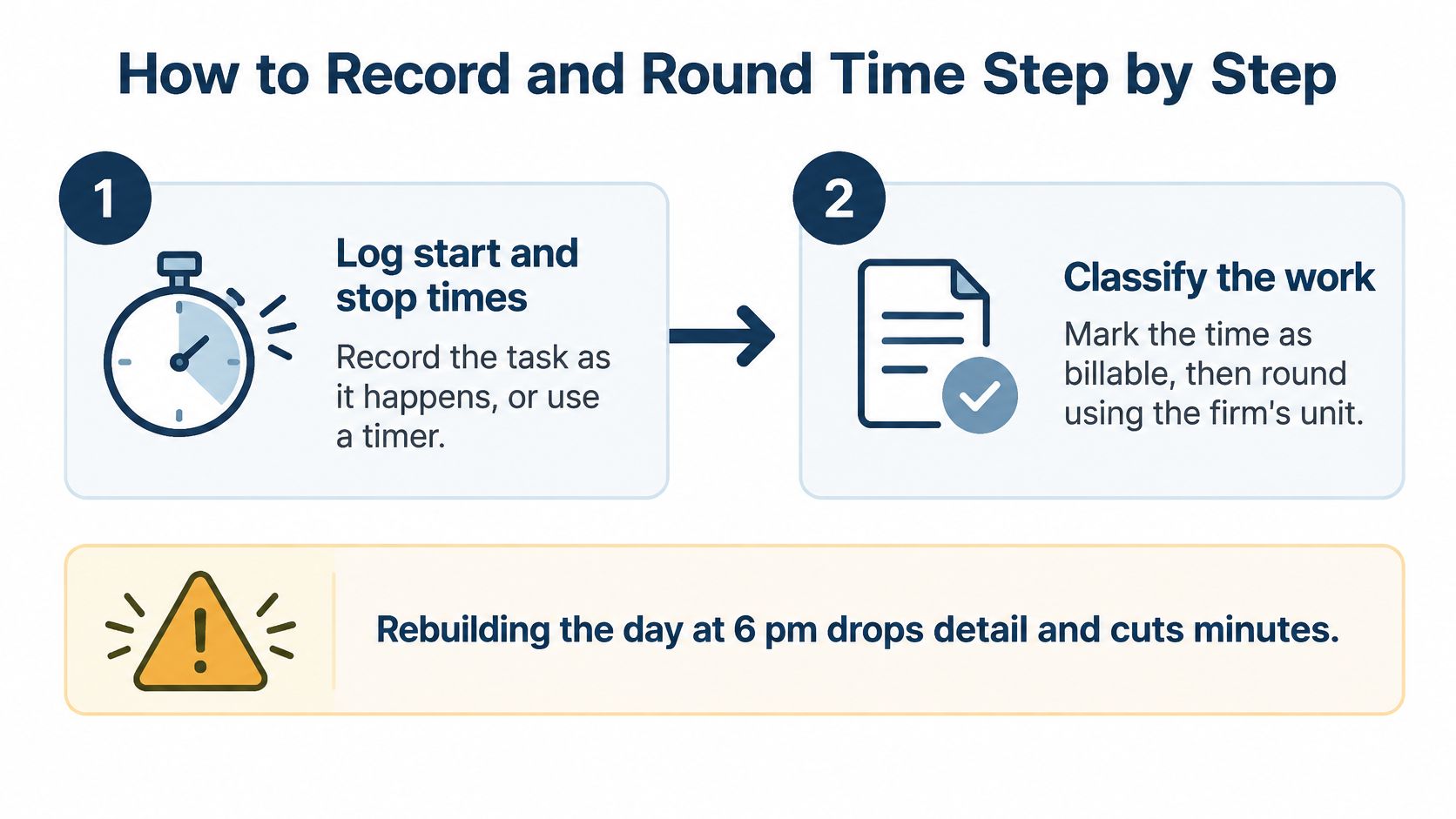
Log start and stop times as the task begins. Use a timer if you have one. Rebuilding the day at 6 pm drops detail and cuts minutes, and it cuts them in one direction. You forget the short tasks, not the long ones.
Classify the work. Mark it billable, non-billable, or pro bono before you do anything else. Classification drives every report later. Get it wrong and your utilization number is fiction.
Convert elapsed minutes into the firm unit. A 14-minute call becomes 0.3 hours under a 6-minute unit. Do the conversion once, at entry, and keep the raw minutes alongside it.
Attach the codes. Matter, client, timekeeper, task, and rate codes all belong on the entry. An uncoded entry can't be billed, can't be reported, and can't be defended if the client asks questions.
Write a narrative that names the work and the result. "Reviewed lease indemnity clause and sent redline to client" survives review. "Contract work" doesn't. Vague text draws write-downs because the reviewer can't tell what the client got.
Check for problems before submission. Look for duplicates. Look for administrative tasks that shouldn't bill. Look for work that sits outside the engagement scope. Catching these now costs seconds. Catching them on a pre-bill costs a partner's afternoon.
Submit approved entries before the billing cutoff. Late entries roll into the next cycle, age badly, and get questioned. Timeliness is part of accuracy.
The daily self-check
Add up the day's billable entries. Then compare that total with the calendar blocks you spent on client work. If the entries sit far below the blocks, you skipped something, and tomorrow you'll remember even less of it.
Picking the right tooling helps here, and this roundup of useful apps for lawyers is a sensible place to compare what your team already uses against what's available. But no app fixes a late entry. The habit comes first.
Rounding Rules That Change Your Totals
Say you take five calls on one matter. Each call lasts 7 minutes. Round each one up to a 6-minute unit and each bills 0.2 hours, so the day totals 1.0 hour.
But you spent 35 minutes. That's 0.58 hours. The rounding didn't just tidy the numbers. It added over 40% to the day, and it did so on completely ordinary work.
Four rules, four different invoices
| Rounding rule | Rule applied | 7-minute entry | 22-minute entry |
|---|---|---|---|
| Round up | Always to the next unit | 0.2 | 0.4 |
| Nearest unit | Closest 6-minute unit | 0.1 | 0.4 |
| Round down | Always to the lower unit | 0.1 | 0.3 |
| No rounding | Exact time | 0.12 | 0.37 |
Round up favors the firm. It also invites pushback, especially on matters full of short touches, because the client sees a string of 0.2 entries for work that plainly took moments. Experienced clients ban it outright in their guidelines.
Nearest unit balances out over a month. Some entries gain, some lose, and the total lands close to actual time. For most matters, I find it's the easiest rule to defend.
Round down favors the client. It leaves real revenue unbilled, without anyone noticing, on every single entry. Nobody notices in week one. By year end it's a meaningful number that nobody chose on purpose.
Exact time removes the argument entirely. It also demands accurate capture, because there's no rounding cushion to hide sloppy start and stop times.
Where the rounding happens
Rounding per entry is the standard approach. Rounding the daily total instead produces a different number, usually a smaller one, because the small overages cancel rather than stack. Use daily rounding only when the client's guidelines allow it. Don't improvise it.
And check who wrote the rule. Pull the engagement letter first. If the client has issued its own billing guidelines, those win, even when they conflict with your firm's default. If the two documents disagree, raise it before the first invoice goes out, not after the first rejection comes back.
Five short calls can bill an hour you didn't work. That's not fraud. That's just per-entry rounding doing exactly what you told it to do.
On fixed-fee and capped matters, rounding won't move the invoice at all. The hours still matter, because they tell you whether the fee covered the work.
Handling Split, Interrupted and Fixed-Fee Work
Real days don't produce clean entries. Work gets interrupted, shared, and rescoped. The answer isn't one big blended entry. It's several small honest ones.
Industry reporting cited by Ravetree on real-time billable utilization tracking puts the estimated accuracy loss at 25%–40% when time is entered after a delay of even one day. That is the main issue. Rounding policy matters less than the gap between doing the work and writing it down.
Six situations that trip people up
Interruptions: You're drafting, and a research question on another matter pulls you away for 20 minutes. That gets its own entry on the research matter if it's billable, billing 0.4 hours under a 6-minute unit. Don't fold it into the drafting entry just because it happened in the middle.
Simultaneous matters: One 30-minute call covers two matters. Record two entries of 15 minutes each. Under a quarter-hour unit, each bills 0.25 hours. Never bill the same minutes twice, even when both clients benefited.
Shared deadlines: A task serves several clients at once. Split the time by a documented share of effort, or follow the allocation in the engagement letter. Write the basis in the narrative so someone else can follow your reasoning six months later.
Internal coordination: Classify it as non-billable unless the client agreed in writing to pay for it. Team calls about staffing, file organization, and internal status updates usually aren't client work, however necessary they feel.
Fixed-fee and capped matters: Rounding won't change what the client pays, but exact hours still drive your margin. Log actual time, then compare the running total against the fee budget each month. That comparison is how you price the next one properly.
Scope changes: The client asks for something outside the engagement. Flag it, and get written approval before you log the time as billable. Unauthorized work is where write-offs are born.
None of this requires special software. It requires deciding the split while you still remember the work. Because by Friday, a 30-minute call that covered two matters has become a 30-minute call on whichever matter you opened first.
Utilization, Realization and Collection Checks
One billable-hours number tells you almost nothing. It can't tell you whether time was recorded, invoiced, discounted, or paid. You need three separate measures, and you need them kept separate.
- Utilization: Billable hours divided by available workday hours.
- Realization: Billed hours divided by billable hours worked.
- Collection: Collected hours divided by billed hours.
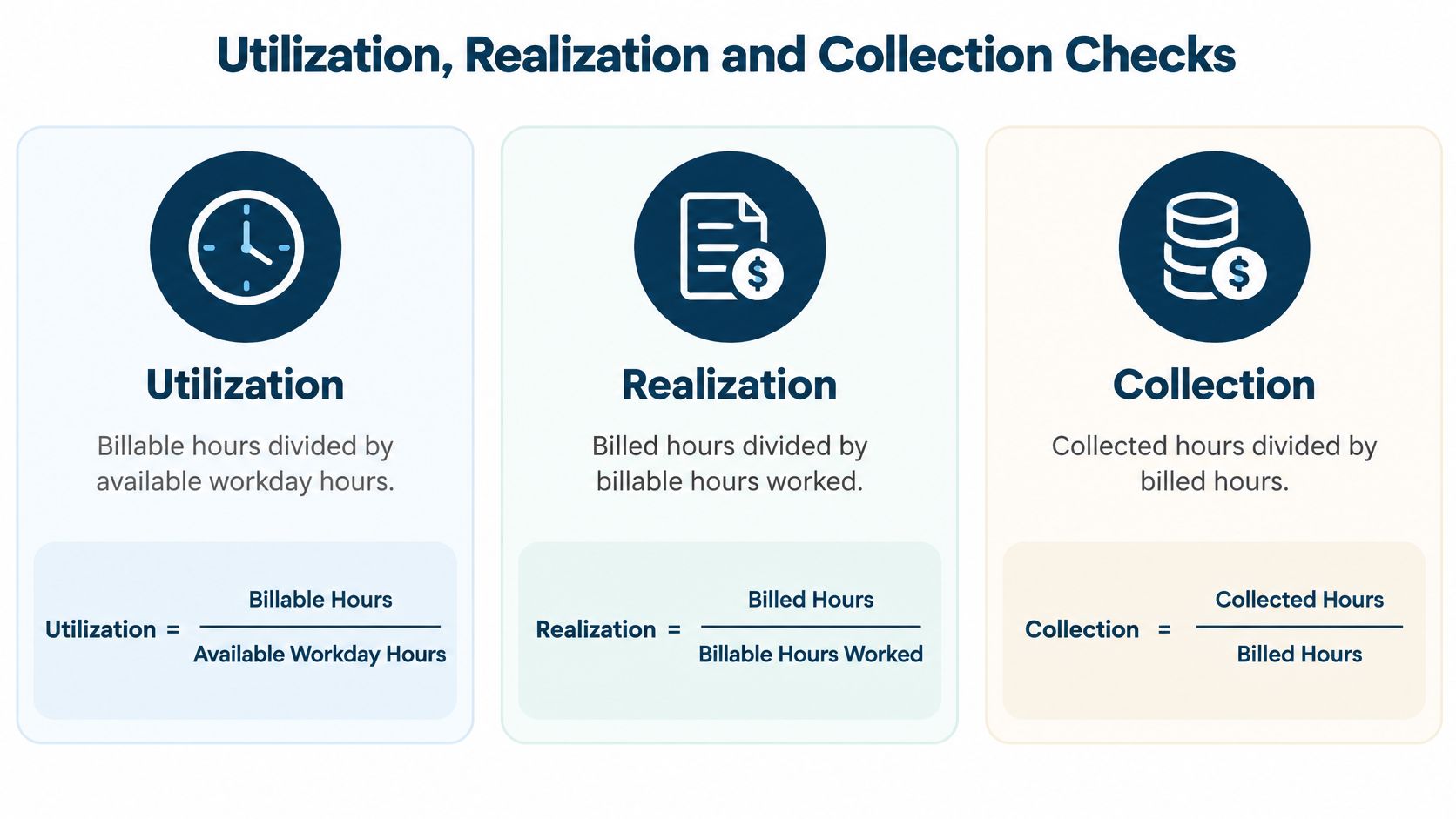
The Clio Legal Trends benchmark data reports average utilization of 38%, about 3.0 billable hours in an eight-hour day, and average realization of 88%. A separate benchmark there puts collection at 93%, leaving roughly 2.4 hours per eight-hour day collected.
| Measure | Formula | Latest benchmark |
|---|---|---|
| Utilization | Billable hours divided by available hours | 38% |
| Realization | Billed hours divided by billable hours worked | 88% |
| Collection | Collected hours divided by billed hours | 93% |
Now multiply. 0.38 times 0.88 times 0.93 is about 0.31, so roughly 2.4 to 2.5 hours of an eight-hour day turn into cash on average. That single calculation explains more about firm economics than any annual billable total ever will.
Two pitfalls that distort the picture
First, don't measure realization against scheduled hours. Measure it against billable hours worked. Mixing the two confuses productivity with billing effectiveness, and you'll chase the wrong fix.
Second, high utilization isn't success by itself. An attorney can log heavy billable time and still generate poor realization through write-downs, fee caps, and clients who don't pay. Read the three numbers together or don't read them at all.
For contrast, the SPI 2025 Professional Services Benchmark Report reported average billable utilization of 66.4% in 2025, below a 75% benchmark. That covers broader professional services work, so don't compare it directly with law firm figures. Different denominators, different work.
If you're building these checks into a wider operating rhythm, this overview of legal operations management covers where the reporting ownership usually sits. Whoever owns it, trend the three measures independently, by matter and by attorney.
Confirm Your Totals Before You Invoice
Lock the increment and the rounding rule for each matter before the next entry gets billed. Not at month end. Not at the pre-bill stage. Now, while changing them is still cheap.
The monthly chain
Pull the source documents. Get the engagement letter and the billing guidelines. Record the unit, the rounding rule, and any cap or fixed fee in one place where the whole team can see them.
Match the records in sequence. Calendar and task records against time entries. Approved entries against invoices. Invoices against cash received. Each step catches a different kind of leak, and skipping one leaves it open.
Note every write-down by reason. "Adjusted" tells you nothing. Vague narrative, out of scope, duplicate, and client courtesy are different problems with different fixes.
Flag aging invoices. An invoice that sits unpaid for an extended period isn't revenue. It's a collection problem wearing a revenue costume, and it should show up in your reporting that way.
Brief everyone who touches time. Attorneys and legal assistants both need the rules, including who enters time when work is delegated. Inconsistent entry habits across a team will defeat a perfect policy.
The stakes aren't theoretical. A small rule error repeated across hundreds of entries becomes a client dispute, and disputes get resolved by crediting invoices. You pay for the mistake twice, once in the credit and once in the relationship.
MatterAlert lets you log billable time directly from tasks and events, tracking billable, non-billable, and pro bono hours, with detailed reports by date, matter, user, or status and task code support. It also logs every change at event and matter levels for audit, with thorough reports by timekeeper, matter, client, or office, plus custom report formats and dashboard analytics. Assistants can manage attorney calendars and their own, create and assign tasks, and handle time entry delegation for attorneys, which matters when the person doing the work isn't the person entering it.
If you're evaluating platforms to run this from, this guide to legal case management software sets out what to compare. Whatever you use, start small. Pick one matter this week and reconcile it fully before you touch the rest. You'll find your firm's specific leak in that one file, and it'll be the same leak everywhere else.
Stop reconciling time from memory, scattered calendars, and spreadsheets that nobody trusts. MatterAlert lets your team capture billable, non-billable, and pro bono time straight from the tasks and events where the work happens, then report it by matter, timekeeper, client, or office with a full audit trail behind every change. Visit MatterAlert to see how it fits your billing cycle, and run your next monthly reconciliation from one record instead of four.