

A case management statement is a required pre-conference filing that tells the court the case's status, readiness, and scheduling needs so the judge can set milestones. In California, each party files and serves that statement no later than 15 calendar days before the conference, on Judicial Council Form CM-110.
The conference is already on your calendar. Counsel has to walk in able to say who has been served, what discovery is left, whether anyone will mediate, and how long trial should run. The statement is the record the judge uses for those calls. It isn't the hearing itself, and it isn't the scheduling order that follows.
Treat the filing as a chain, not a one-off PDF. Conference date, meet-and-confer, filing, service, and proof of service each need an owner. Miss one link and a clean draft still leaves the file unready.
What a Case Management Statement Is and Why Courts Require It
Monday morning, the conference is ten days out and the draft is still a shell. Partners want a status. The docketing desk wants a date it can tick. The judge wants something else: a document that can be used to run the case.
A case management statement is a decision-input document. The court reads it to evaluate scheduling, discovery, settlement, motions, and trial planning. It is not a narrative the bench skims for color. Under California's framework, the court reviews each case and decides issues that include alternative dispute resolution, trial setting, and other procedural management. Counsel must appear as directed, know the file, and be ready to discuss and commit to positions on those issues, as California Rule of Court 3.722 requires.
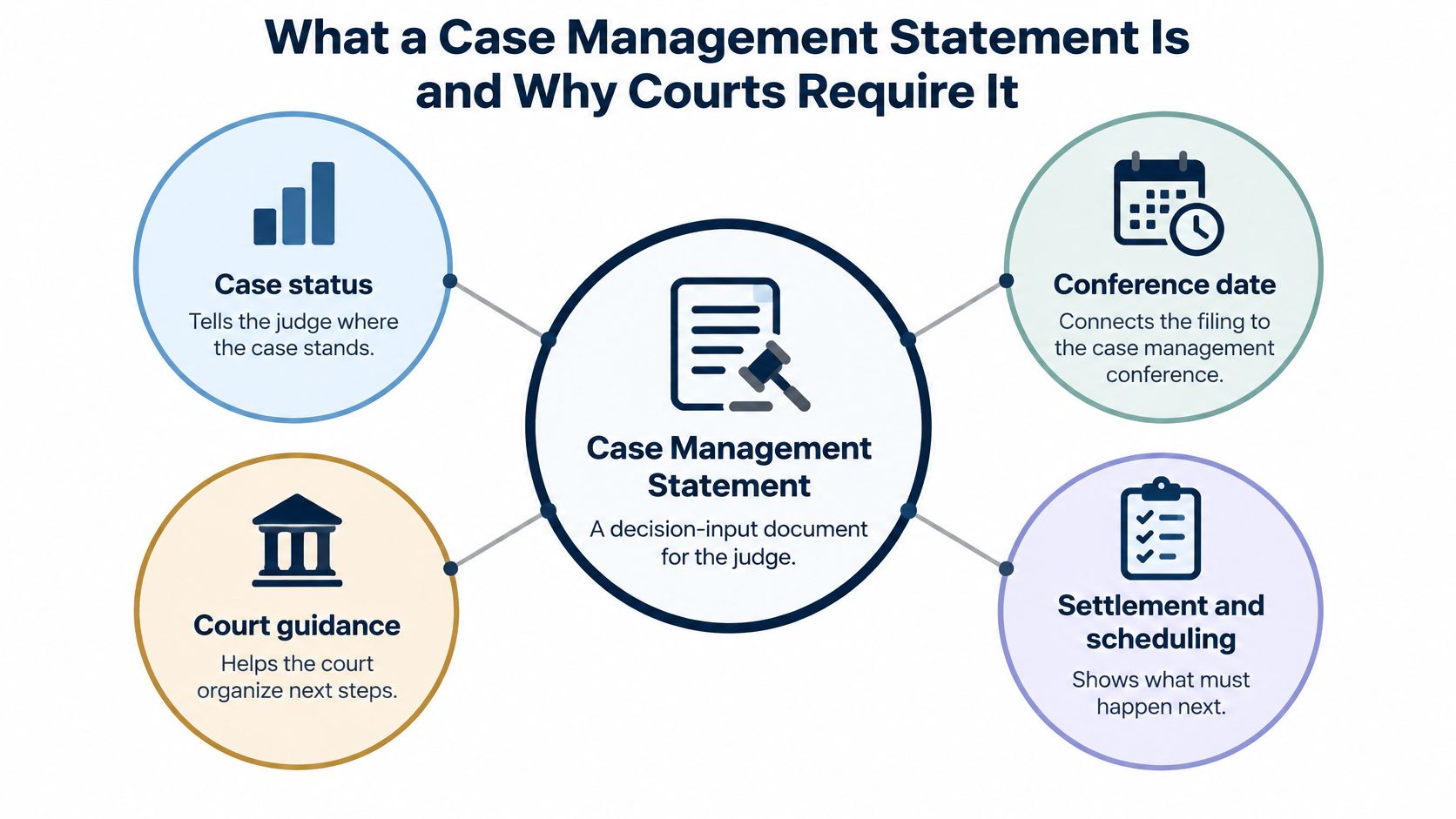
Who files it and what the court does with it
Each party files, or the parties file jointly. The court uses the answers to set the next milestones. A vague ADR line, or a discovery section copied from an older draft, gives the bench nothing solid to schedule against.
Three records get mixed up in busy offices.
- The statement: What the parties say the case needs before the hearing.
- The conference: The live discussion where counsel has to stand on those positions.
- The order that follows: The controlling dates. If the statement and the minute order disagree, the order wins.
What a late or missing filing costs
Yolo County states that failure to file, or a late filing, inconveniences the court and may bring an order to show cause. It also notes that a trial date may be set at the first conference. Showing up familiar with the case is part of the same duty. A partner who hasn't read the draft can't commit to a mediation window or a trial length in open court.
Practical rule: If the person appearing can't defend every date and position in the draft, the statement isn't ready, even if the PDF is formatted.
The stake is simple. The judge is building a schedule from what you put on the form. Thin answers produce thin orders, or an order to show cause you didn't budget for.
What Goes Into a Case Management Statement
Read the draft in the order a judge reads it. Each block answers a scheduling question. A weak answer doesn't just look sloppy. It stalls the conference.
Parties, court power, and what's left to do
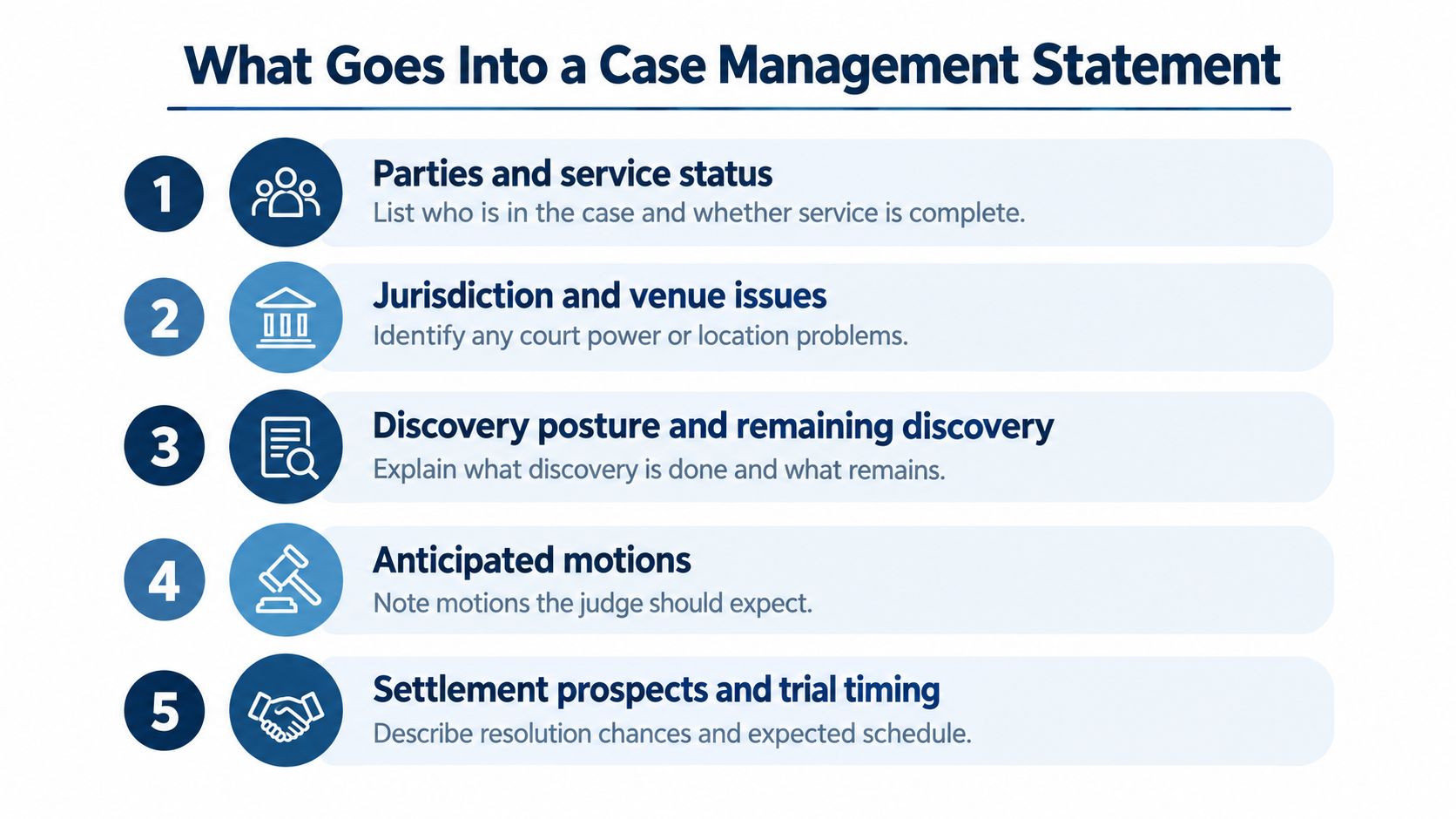
Parties and service status come first. List who is in the case and whether service is complete. Unserved defendants, Doe defendants still on the caption, or a cross-complaint nobody has answered all change what the court can set. "All parties served" with no dates forces the judge to ask questions you should have answered on paper.
Jurisdiction and venue come next. Flag any challenge, any pending motion, and any agreement on forum. A silent box reads as "no issue." If a motion to quash is on file, the conference will set dates the motion may wipe out.
Discovery posture is where drafts go stale. Say what is done, what is outstanding, and what you still intend to serve. "Discovery ongoing" tells the court nothing about depositions, experts, or a cutoff. Judges weigh this block heavily because it drives the rest of the calendar. A proposed trial date that ignores three unscheduled depositions will not survive the hearing.
Motions, resolution, and trial
Anticipated motions should name the motion, the target, and a realistic filing window. "Possible summary judgment" without a month is boilerplate. The court can't reserve a hearing date from a maybe.
ADR position needs a real yes, no, or not yet, plus timing. Willingness to mediate in the abstract, with no owner and no window, becomes a commitment nobody tracks after the hearing. The statement should report case status, expected trial length, ADR willingness, and readiness for trial, which is the point of the court's own case-management guidance.
Estimated trial length, witnesses, and evidence belong together. Days of trial, a rough witness count, and any exhibit or expert constraint tell the court whether the case fits a short-cause calendar or needs a longer setting. Round numbers with no basis get challenged from the bench.
Proposed scheduling constraints close the draft. Vacations, a related case, a pending motion, and expert availability all belong here. Leave them out and the order will ignore them.
Before you file, audit the draft against that sequence. If a line could be pasted into any other case, rewrite it. The dates you propose here should also line up with how your team will later track a case management order, because the order, not the draft, becomes the controlling calendar.
A technically complete form that repeats last quarter's discovery assumptions will still fail at the conference.
Filing Deadlines Service Rules and the Mandatory CM-110 Form
Build the countdown backward from the conference date. One rule creates five events. If your calendar stores only "CMS due," you will miss at least one of them.
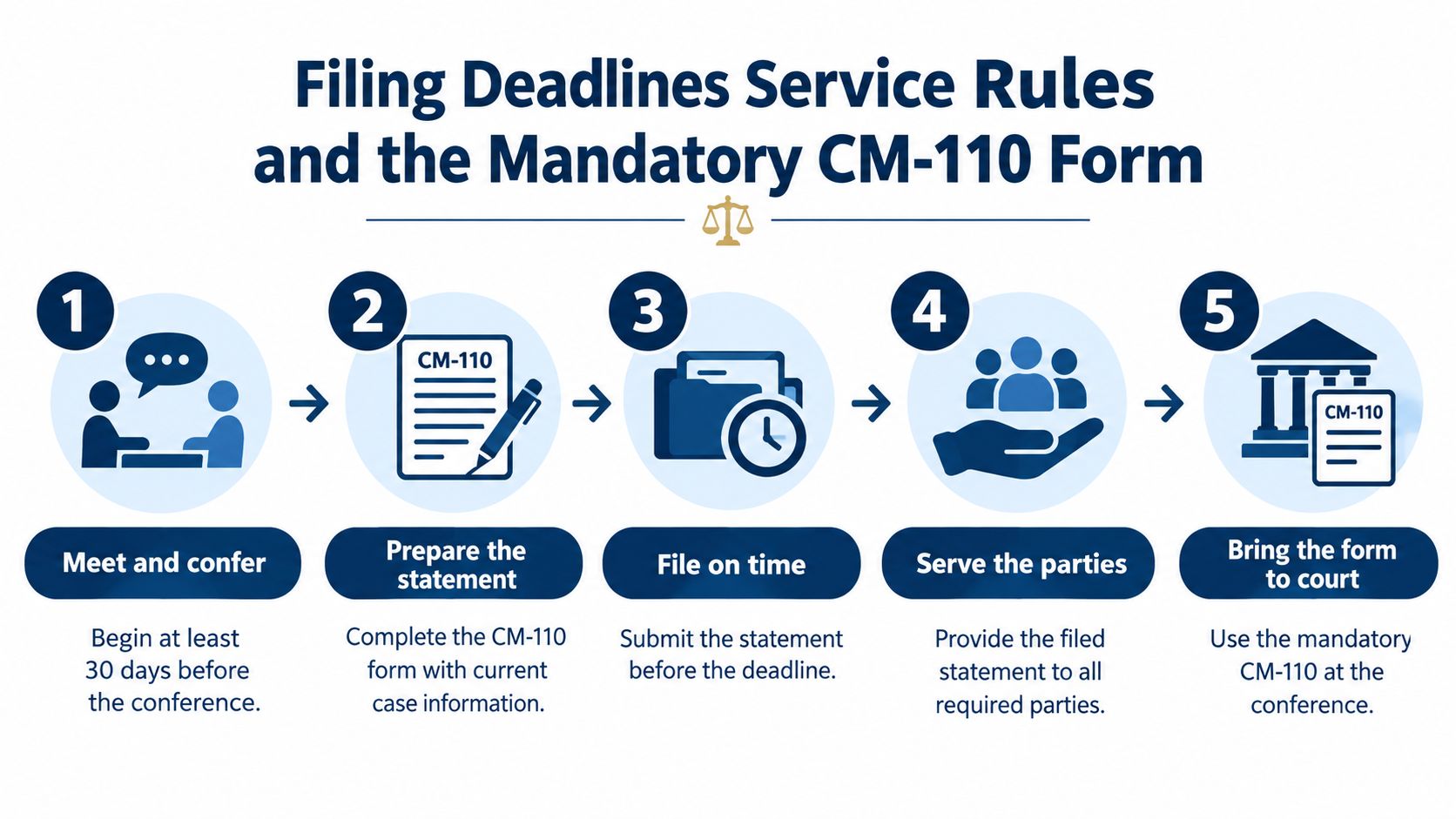
California formalized the modern requirement in California Rule of Court 3.725, effective January 1, 2007. Each party in a civil action must file and serve a case management statement no later than 15 calendar days before the scheduled case management conference or review. Parties may file a joint statement instead. Either way, the filing uses Judicial Council Form CM-110, and all applicable portions must be completed. Statewide guidance repeats that 15-day filing-and-service rule and tells parties to start earlier, including a meet-and-confer at least 30 days before the conference. The text of Rule 3.725 is the anchor for the whole chain.
The chain, counted backward
- Conference date. This is the trigger. Every other date hangs off it. Confirm the hearing on the notice, not from memory.
- Meet-and-confer, at least 30 days out. Trade service status, discovery left, ADR position, and a proposed schedule. A joint statement is easier when this call takes place. A separate statement is the fallback when positions don't match.
- Draft and attorney sign-off. Complete CM-110. Blank applicable sections are not optional. Complex cases may need a different joint format, covered below. Don't force a complex matter onto a form the court has already said doesn't fit.
- File no later than 15 calendar days before the conference. Count calendar days, not court days. A weekend or holiday inside the window doesn't add time unless a local rule says so. Check the local rule before you assume it does.
- Serve the same deadline, then complete proof of service. Filing without service, or service without a proof in the file, still leaves the chain open.
Why the 2007 form still matters to docketing
The 2007 effective date set a uniform statewide framework. The mandatory form standardized what courts receive in ordinary civil cases. For a docketing team, that uniformity is useful only if each event is a separate tickler: conference, meet-and-confer, filing, service, proof of service.
A joint statement saves a second filing when the parties agree. It fails when one side's discovery story is wrong and both names are on the caption. If you can't reconcile the facts before the 15-day mark, file your own CM-110 and say where you disagree.
Count backward on a real calendar. "About two weeks" is how 15 calendar days gets missed.
Recurring Conferences and Complex Civil Cases in California
The first statement is not the last one. In a long case it becomes a governance record: what you promised last time, what happened, and what you want next.
California's complex-civil guidance states that the first case management conference is generally scheduled 120 days after an action is filed. Courts may schedule additional status conferences about every 120 days as the matter moves. That interval is why a docketing system built for a single intake form falls apart by the second hearing. Each cycle needs a fresh comparison of planned milestones against actual progress.
The complex track runs on a shorter clock
Complex matters use a different paper. Santa Clara County's guidelines permit a joint statement filed no later than five calendar days before the hearing. The statement is expected to cover an objective summary, prior conference orders, compliance progress, likely procedural or practical problems, proposed efficiency measures, and a timeline of key events. The same guidance says the standard CM-110 form is not well-suited to complex cases. Forcing a complex matter onto CM-110 drops the progress-and-risk topics the court wants. Those topics are spelled out in the Santa Clara complex civil guidelines.
What changes in practice:
- Five days, not fifteen. The complex joint statement has its own trigger. Don't reuse the ordinary CM-110 tickler.
- Progress against prior orders. The draft has to answer what the last minute order required, not restate the complaint.
- Problems and a timeline. Name the bottleneck and propose a fix. A timeline of key events is the point of the filing.
Volume, and why the digital file still needs owners
The Judicial Council of California reported that about 150,000 remote civil proceedings were conducted statewide each month in a recent reporting period. More than 90% of court users and 98% of court staff surveyed reported positive experiences with remote proceedings. Those figures cover civil proceedings generally, not case management statements alone. They still describe the setting: high volume, remote hearings, and notices that move fast.
But a remote conference doesn't shrink the work after it. Someone still has to pull every date out of the minute order, compare it to the statement, and update the calendars. A recurring 120-day cycle with no owner is how "we filed on time" turns into a missed expert cutoff three hearings later.
How Federal Courts Handle Scheduling Under Rule 16
Federal court generally doesn't ask for a case management statement on Form CM-110. Federal Rule of Civil Procedure 16 gives the judge a timetable for a scheduling order instead. Unless the judge finds good cause for delay, the order must issue as soon as practicable, and no later than the earlier of 90 days after any defendant is served with the complaint or 60 days after any defendant appears. The order may cover required disclosures, discovery limits, motions, electronically stored information, and trial dates. Rule 16 is the whole clock.
Two triggers, one controlling date
One civil case produces several linked deadlines from a single trigger event. You need both the service date and the appearance date. Then you compare them.
Say the defendant is served on March 1 and appears on March 20. Ninety days from service is May 30. Sixty days from appearance is May 19. The earlier date controls, absent good cause. A calendar that stores only "case management" cannot reproduce that comparison. If the court later changes the order, the ticklers have to move with the amended order, not stay glued to the original calculation.
| Requirement | California State Courts | Federal Courts |
|---|---|---|
| Main instrument | Case management statement on Form CM-110, or a complex joint statement | Scheduling order under Rule 16 |
| Primary trigger | Date of the case management conference or review | Service of the complaint, and any defendant's appearance |
| Filing or issuance timing | Statement filed and served 15 calendar days before the conference; complex joint statement 5 calendar days before | Order as soon as practicable, and no later than the earlier of 90 days after service or 60 days after appearance |
| What you record first | Conference date, then meet-and-confer, filing, service, and proof | Service date and appearance date, then the earlier of the two calculated deadlines |
| What breaks the calendar | One of the five chain events with no owner | A single "CMC" date that ignores which trigger controls |
Which regime you are in
State superior court in California: record the conference date first and build the statement chain. Federal district court: record service and appearance first, calculate both Rule 16 dates, and keep the earlier one as the controlling deadline unless the judge finds good cause. A case that moves from state to federal doesn't carry the CM-110 tickler with it. Reset the triggers the day the notice of removal hits the file.
Mistakes That Make a Timely Statement Fail in Practice
Filing on time is not the same as being ready. A CM-110 can hit the 15-day mark and still hand the court a schedule nobody can keep.
The usual failures survive a compliant filing.
Stale discovery. The draft was copied forward. Two depositions got taken, one didn't, and the statement still lists all three as "to be scheduled." The cutoff the judge sets will be wrong on day one.
An ADR commitment with no owner. The form says the parties will mediate within 90 days. Nobody is tasked to pick a mediator, hold dates, or report back. The next status conference opens with a broken promise.
A schedule that never reaches the calendars. Proposed dates live in the PDF and in one attorney's head. Staff calendars, the trial calendar, and the expert's calendar never get the update. That gap is the same exposure firms hit with manual legal calendaring.
No reconcile against the minute order. The statement proposed June. The order says August, with a different discovery close. If nobody extracts the order, the team keeps working the draft.

A closed loop you can run this week
Courts are told to control pace, track a case from filing through disposition, and cut unnecessary delay. A statement that hides execution risk works against that job. Run this loop instead.
- Extract every commitment from the statement and from the minute order. Dates, ADR, motion windows, discovery limits.
- Assign an owner to each one. A commitment without a name is a wish.
- Record trigger dates and dependencies. Expert disclosure that depends on a deposition doesn't get a date until the deposition does.
- Link the supporting paper. Notice, proof of service, and the order, in the matter file.
- Escalate before the filing deadline. Incomplete sections and missing sign-off should surface while you can still fix them.
Same-day audit before you file: conference date confirmed, meet-and-confer done or documented, CM-110 complete, service plan set, proof-of-service task open, and every proposed date already on someone's calendar. If any box is empty, you are early enough to fix it only if you are still ahead of the deadline.
Key Takeaways and a Practical Next Step
Four things are worth keeping in the file notes.
The statement is a decision input for the judge, not cover paperwork. Its contents map to what the court has to schedule: service, jurisdiction, discovery, motions, ADR, trial length, and constraints. California's CM-110 rule creates a chain of trackable events off the conference date, and the 2007 form is what ordinary civil departments expect. Federal cases and complex civil cases run on different clocks. Rule 16 uses service and appearance. Complex California cases use a joint statement five calendar days out, on a cycle that often repeats about every 120 days.
The highest-risk habits are the quiet ones. Counting 15 days as court days. Reusing a CM-110 tickler on a complex matter. Storing one "case management" date for a federal case that has two triggers. Leaving ADR and discovery promises in the PDF after the order issues. And treating a timely filing as proof the team is ready.
Replace the countdown spreadsheet
Teams that file across states can't keep those chains in a shared spreadsheet and a memory of local rules. MatterAlert puts CalendarRules deadline calculation, PACER and UniCourt docket access, matter templates, tasks, audit logs, and Outlook synchronization in one matter-centered platform. CalendarRules tracks critical trigger dates for courts across North America with 2,200+ rule sets, calculates deadlines with weekend and holiday adjustments, and updates calendar events when a court updates its rules. Docket availability and rule coverage vary by court and jurisdiction, especially in Canada, so confirm the specific courts and rule sets on your docket before you rely on a calculation.
Start with the triggers you already have: conference date in state court, service date and appearance date in federal court. Put an owner on filing, service, and the post-order reconcile. Then check that your rule set matches the court that will hear the case.
MatterAlert calculates court deadlines from the trigger dates on your matters, monitors dockets, and syncs the resulting events to Outlook so a case management statement chain doesn't live in one person's inbox. If your team is still counting conference, filing, and service dates by hand across state and federal calendars, MatterAlert can show you how those rule sets and docket tools fit the courts you file in.