
The client has hired replacement counsel, discovery is still moving, and tomorrow's hearing remains on the calendar under the departing attorney's name. Someone emails a signed substitution and asks you to “update everything.” Before changing the attorney-of-record field, you need to know what was signed, where it was filed, who was served, and whether the change covers the entire matter.
A California substitution of attorney isn't just a form-processing task. It's a transfer of responsibility that needs separate controls for ordinary civil cases, contested withdrawal, limited-scope representation, and appellate proceedings.
Why California Substitution of Attorney Matters at Any Stage
A client switching firms creates an obvious handoff. A lead associate leaving during discovery creates a less obvious question: does the departure require a formal change of counsel, an internal reassignment, or both? Limited-scope counsel completing a task presents another question entirely. Start by identifying the representation that needs to change, rather than assuming every personnel change requires the same filing.
California Code of Civil Procedure section 284 permits an attorney in an action or special proceeding to be changed “at any time before or after judgment or final determination.” It provides a consent route, filed with the clerk or entered in the court minutes, and a court-order route after notice to the other party.
Separate the legal change from the operational handoff
That statutory language matters when a matter looks finished but still needs attention. A judgment doesn't make representation changes irrelevant. Firms should keep the ability to record a counsel transition throughout the matter's lifecycle, rather than treating substitution as something that happens only during intake or active discovery.
The operational question is broader than who appears on the next pleading:
- Representation status: Identify who is leaving, who is entering, and which party each attorney represents.
- Responsibility: Assign someone to review outstanding work while the change is pending.
- Communication: Decide who monitors incoming notices during the handoff.
- Historical accuracy: Preserve the prior attorney information instead of overwriting the record without an effective-date history.
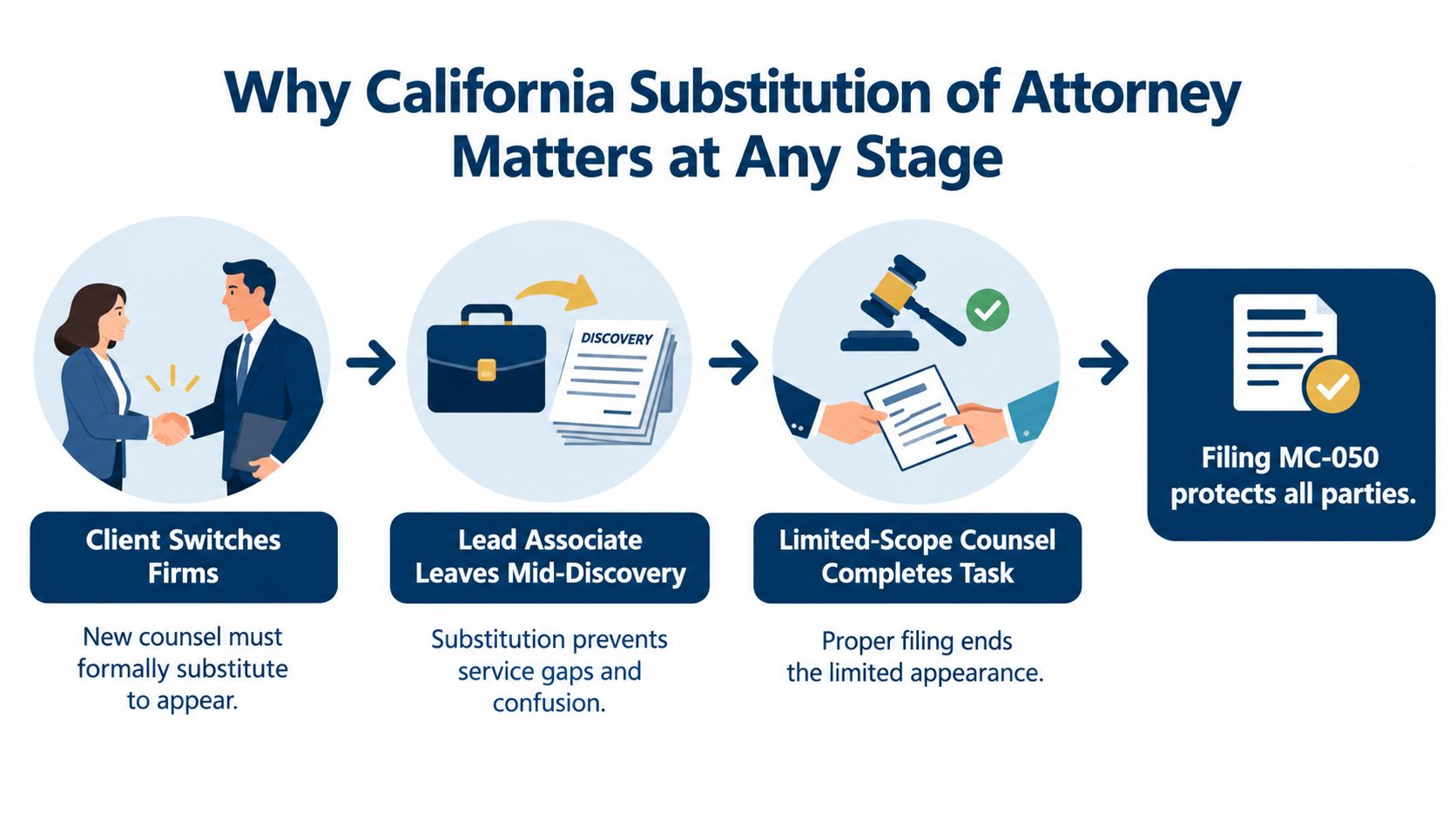
Treat the image as an overview, not a substitute for identifying the correct procedure. Completing a limited assignment, replacing counsel by consent, and obtaining permission to withdraw aren't interchangeable events.
Practical rule: Open a transition task when the firm learns counsel may change. Close it only after someone verifies the applicable procedural endpoint.
A useful intake question is simple: Which workflow applies? Answering that before circulating paperwork prevents the team from chasing signatures on a consensual form when it needs a court order or a separate appellate filing.
Filing MC-050 the Right Way in a Standard Civil Case
For a consensual change in an ordinary civil case, Judicial Council form MC-050 is the working document. It can cover replacement counsel, a represented party proceeding without counsel, or a self-represented party hiring counsel. The California Courts substitution instructions explain that the represented party, former attorney, and new attorney generally complete and sign page 1, and that there is no filing fee.
Prepare the filing as a complete packet
Check the form against the existing matter record before requesting signatures. Compare the party designation, case number, court information, and attorney contact details. A correctly signed form still creates a bad handoff if the team associates it with the wrong party or carries an obsolete address into the service list.
The filing sequence should distinguish preparation from completion:
- Obtain signatures: Confirm that the applicable signature fields are completed, rather than treating a partially signed draft as ready to file.
- Arrange mailing: The mailer must be at least 18 years old and not a party to the case, under the California Courts instructions linked above.
- Complete proof of service: Have the mailer complete and sign page 2, documenting the mailing before the completed original is submitted.
- Submit and verify: Retain the filing confirmation and check the court's response instead of assuming transmission means completion.
The proof of service documents the service step for the filing packet. It isn't an administrative attachment to reconstruct later from an assistant's sent email.

Don't confuse clerk review with deadline ownership
Missing signatures and an incomplete proof are concrete defects to catch before submission. But clerk acceptance shouldn't be treated as confirmation that your firm assigned every pending hearing or notified everyone who needs the new attorney's information.
Record the signature, mailing, submission, and filing information separately. Have the responsible attorney confirm the effective representation status using the filed document and any applicable court direction.
Until the substitution is filed and effective, papers and court communications may continue to involve existing counsel. Keep transition monitoring in place during that interval. Removing the departing attorney from every notification before verifying completion is faster, but it leaves nobody checking whether the handoff worked.
When You Cannot Get Consent and Need a Court Order
An unsigned MC-050 isn't a completed substitution. If the necessary consent isn't available, stop treating the problem as a signature-chasing exercise and ask the attorney to select the court-order procedure.
The official text of Code of Civil Procedure section 284 permits either the client or attorney to apply for an order after notice to the other. An attorney who can't obtain a consensual substitution generally must seek court permission to withdraw rather than stop working.
Consent and court permission require different controls
| Issue | Consensual substitution | Court-order-dependent change |
|---|---|---|
| Basis for proceeding | Required participants consent | Moving party requests judicial relief |
| Essential record | Completed substitution and service documentation | Motion, notice, service record, and resulting order |
| Operational concern | Confirm filing and effective status | Track the request through the court's disposition and any conditions |
For the noticed route, the moving attorney should determine the applicable motion requirements and ensure the other party receives the required notice. Don't assume that emailing an unsigned substitution supplies the notice needed for judicial relief.
The court, rather than the filing clerk processing a consent form, must decide whether to grant the requested change. The attorney should evaluate the request against the applicable withdrawal requirements and the matter's posture. Don't promise a client that relief will be granted merely because a replacement firm has agreed to take over.
A request to withdraw isn't permission to withdraw.
Read the order before changing the record
The resulting order controls what relief the court granted. Read it for the attorney and party affected, any conditions, and the point at which the relief becomes effective. Don't reduce the result to “motion granted” without preserving those details.
For docketing purposes, separate the hearing outcome, order entry, required follow-up, and confirmed effective date. Those events may not coincide. Assign an owner to any remaining service or filing task, and retain a review flag until counsel confirms the order's requirements have been satisfied.
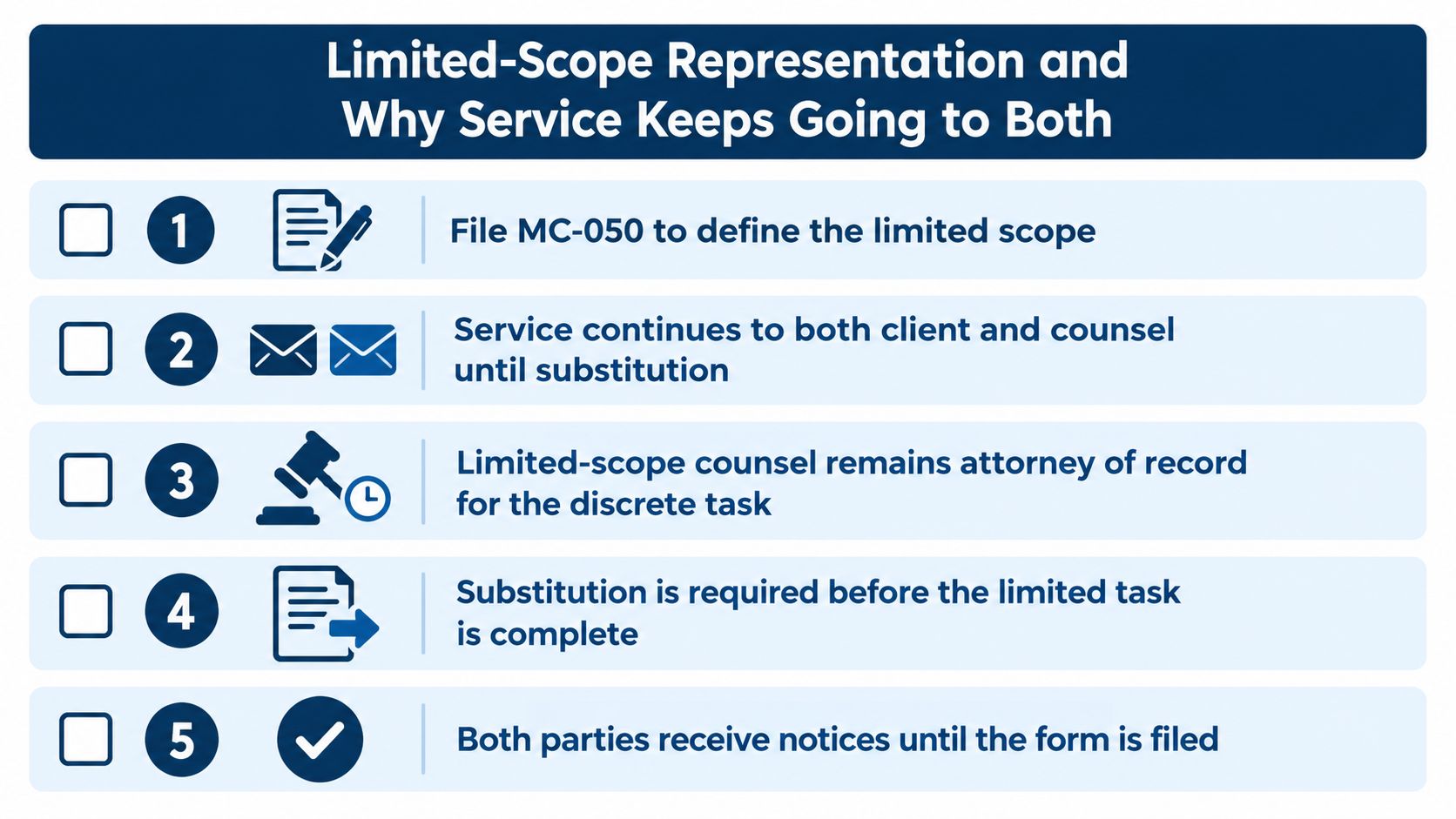
Limited-Scope Representation and Why Service Keeps Going to Both
Suppose an attorney handles only depositions, while the client manages the rest of the case. The final deposition concludes, and the team marks the assignment complete. That internal completion status doesn't, by itself, establish that the attorney's procedural connection to the matter has ended.
Under California Rule of Court 3.36, limited-scope representation requires attention to the specified hearing, trial, task, or duration. During that representation, papers generally must be served on both the limited-scope attorney and the client. The rule also provides a route for counsel seeking relief when the client hasn't signed MC-050.
Track the scope separately from the exit document
A limited-scope record needs more detail than an attorney's name and a general “active” checkbox. Preserve the description of the assignment and the document that establishes how counsel's involvement ends.
For the deposition example, distinguish these events:
- Substantive work completed: Counsel has finished the agreed deposition work.
- Procedural exit pending: The appropriate substitution, completion procedure, or request for relief still needs attention.
- Exit verified: The required document has been filed and served, and an attorney has confirmed the representation status.
Family-law limited-scope matters have parallel controls under Rule 5.425. Until an MC-050, a final FL-955 notice, or an order relieving counsel is filed and served, the attorney remains connected to the matter under that rule. FL-955 is a family-law completion mechanism, not a universal replacement for the civil procedure.
Use the applicable rule, not a generic checklist
The procedural distinction matters: MC-050 isn't the document that defines every limited-scope engagement, and completing the assigned task isn't the same as completing the exit procedure. Use the governing civil or family-law rule to identify the necessary document and service endpoint.
Service safeguard: Don't remove either recipient merely because someone says the limited assignment is finished.
Keep the scope description visible to the person maintaining service contacts. Otherwise, staff may remove counsel too early or continue treating counsel as responsible for work outside the engagement. Both problems start with the same database shortcut: using a single attorney-of-record field to describe a representation that has boundaries.
Trial Court Versus Appellate Substitution
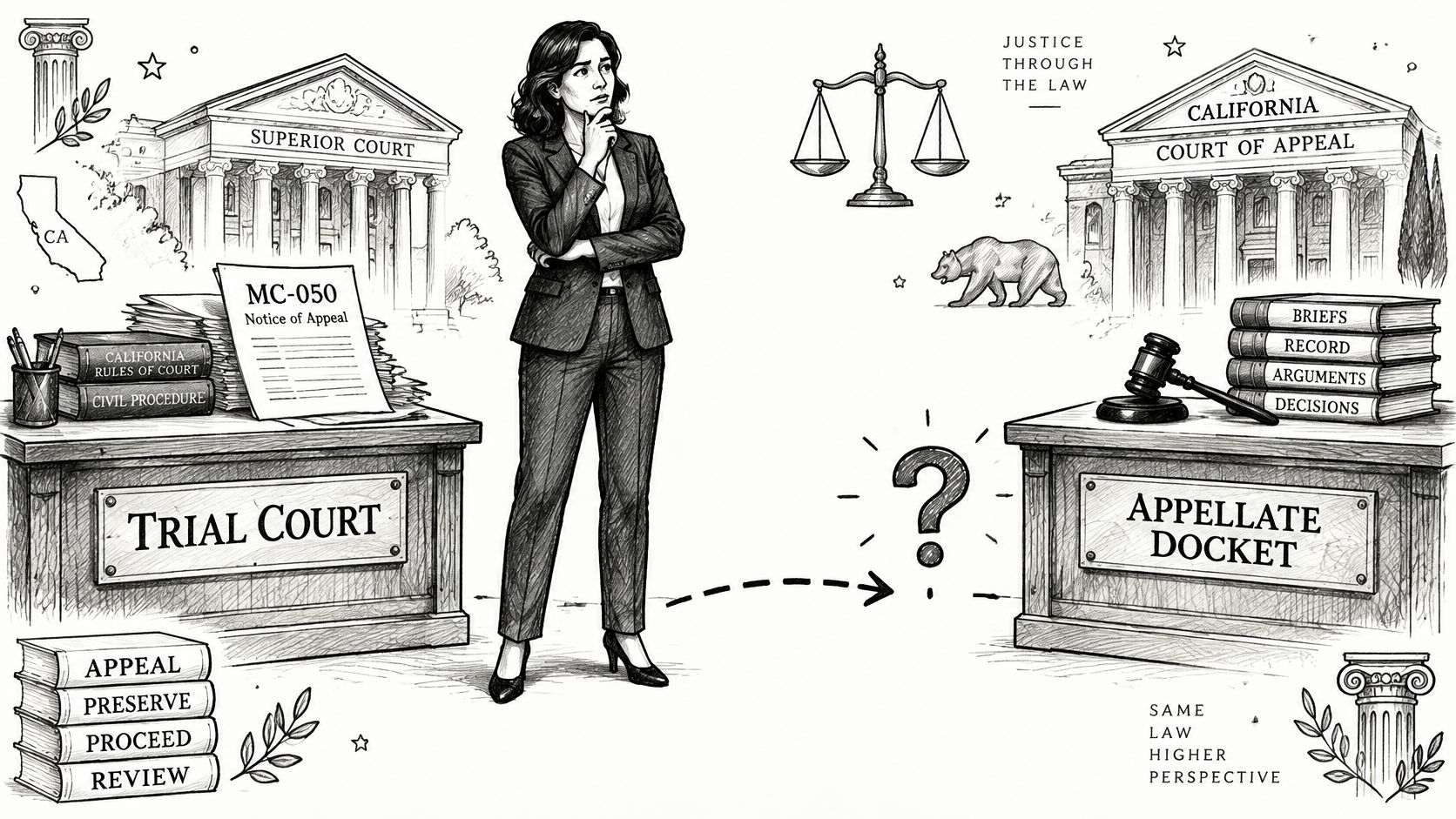
Does a trial-court substitution automatically apply on appeal? No. A superior-court filing doesn't replace the separate appellate procedure.
California Rule of Court 8.36 requires an appellate substitution signed by the represented party and new attorney to be served and filed in the reviewing court. When the appeal arises from a superior-court proceeding, the superior court must also be served. That distinction is important: the rule calls for filing in the reviewing court and service on the superior court, not an assumption that filing MC-050 below updates both records.
Follow the proceeding, not just the client name
Consider a matter in which the notice of appeal is already on file when the client changes firms. The trial team completes its substitution and updates its internal contacts. The appellate team still needs to verify the reviewing court's representation record and complete the appellate procedure.
Treat the records as related but distinct:
- Superior-court component: Confirm the status of the trial-court representation change.
- Appellate component: Prepare the substitution required for the reviewing court.
- Cross-court notice: Verify service on the superior court where required.
- Deadline responsibility: Obtain express confirmation of who owns the pending appellate work.
Don't let the trial handoff conceal appellate work
An internal contact update can make the transition look complete while the reviewing court still has different information. The practical risk is that the team responsible for an appeal doesn't receive, recognize, or act on a notice that remains tied to the prior representation record.
Check for an active appeal or writ proceeding when opening the transition task. Review the appellate docket independently, identify any pending briefing obligation, and name the attorney who will supervise it during the change.
Avoid a generic “file in both courts” instruction. It can obscure the difference between filing and service and encourage staff to submit the wrong document. Write the required action beside each court's name, then retain separate evidence that each action occurred.
A unified client file is convenient. Separate procedural completion records are safer because they show exactly which court has received what.
Turning the Procedural Steps Into Docketing Checkpoints
A defensible transition workflow needs more than a completed-form checkbox. Use distinct statuses for preparation, service, submission, acceptance, attorney review, and downstream reassignment. That structure lets a docketing supervisor see whether a matter is waiting on a signature or sitting with an unresolved court response.
California Substitution Checkpoints by Workflow Type
| Workflow | Key Checkpoints | End Condition |
|---|---|---|
| Standard civil consent | Applicable signatures, mailing, completed proof, filing verification | Filed substitution and confirmed effective status |
| Contested withdrawal | Notice, motion, hearing, order review, required follow-up | Relief effective under the order |
| Limited-scope representation | Scope record, applicable exit document, filing and service verification | Procedural exit confirmed under the governing rule |
| Appellate substitution | Reviewing-court filing, required service, appellate ownership review | Appellate representation update verified |
Make responsibility a required field
Before changing the attorney-of-record field, require attorney review of the effective date and scope. Then audit upcoming hearings, briefing dates, discovery cutoffs, service recipients, calendar subscriptions, and escalation contacts.
Use matter templates to require those checks. Bulk reassignment can move tasks and events efficiently, but it shouldn't decide whether an assignment falls inside a limited engagement. Rules-based calendaring tools such as CalendarRules can support deadline administration, while attorney review determines whether a representation change supplies any relevant trigger.
The same distinction underlies the risks of manual legal calendaring: a date can be present on a calendar and still lack a responsible owner. Require incoming counsel to acknowledge the pending-work inventory rather than relying on a mass reassignment notice.
Escalation control: A rejected filing should reopen the transition task, preserve monitoring by the existing team, and notify the responsible attorney.
Measure the process your firm actually runs
The California procedural sources discussed here don't publish statewide substitution success or error benchmarks. Don't attach an assumed performance rate to the workflow.
Measure your own first-filing acceptance rate, elapsed time from signature to clerk acceptance, and rejection reasons involving proofs or service lists. Keep those categories separate. A delay awaiting consent calls for a different operational response than a packet repeatedly returned for correction.
Common Rejection Reasons and a Final California Substitution Checklist
Some problems threaten filing acceptance; others occur after a perfectly acceptable filing. Missing applicable signatures, an incomplete proof, or an ineligible mailer belong in the prefiling review. Failure to complete the appellate procedure or premature reassignment belongs in the transition audit.
Don't describe all of them as clerk rejections. A clerk won't validate your internal calendar ownership, and filing acceptance won't establish that the appellate team received its handoff.
Run the final review against the actual workflow
- Signatures: Confirm the applicable participants signed the correct document.
- Mailing: Verify the mailer meets the eligibility requirements already identified.
- Proof: Retain completed service documentation with the filing record.
- Court action: Confirm filing, acceptance, and any required order or follow-up.
- Attorney approval: Obtain review of scope and effective status.
- Notifications: Update service contacts, assignments, subscriptions, and escalation recipients.
- Related proceedings: Check each active court component independently.
Docket monitoring is useful, but coverage must match the court. For firms handling related federal matters, PACER integration belongs to that federal monitoring workflow. It isn't proof that a California state-court representation update occurred.
The continuing-case-management principle in section 284 should shape the firm's closing check: do not disable transition controls solely because the matter has reached judgment. Finish with a verified representation record, a named owner for pending work, and documented notice to the people who need it.
MatterAlert offers centralized matter records, docketing, calendaring, task reassignment, and escalation tools to help teams manage counsel transitions. Visit MatterAlert to explore how matter templates and coordinated calendars can support separate substitution workflows without losing sight of pending deadlines.